
In today’s Gulf Cooperation Council (GCC) markets, spanning the UAE, Saudi Arabia, Qatar, Kuwait, Bahrain, and Oman, client retention in the GCC is no longer a passive outcome of good service. It is an active, data-driven discipline that separates high-growth businesses from those quietly losing ground to competitors.
The overall GCC has experienced a fundamental shift in its business landscape. Digital transformation initiatives, like Saudi Arabia’s Vision 2030 and the UAE’s National Innovation Strategy and the large amount of foreign direct investment flowing into the region, are changing the way B2B buyers view their businesses. The surge in enterprise SaaS adoption across sectors from fintech to logistics has raised the bar for what clients expect from the vendors and partners they choose. Entering into a contract is no longer the end of the process; it is the beginning of a long-term partnership that must be built on a solid foundation of trust and respect.
The challenge for customer success professionals throughout the region is clear: how can you provide an authentic, genuinely personal experience to dozens or hundreds of customers at the same time, without sacrificing quality or consistency?
The answer lies in what the most forward-thinking teams in the GCC are already doing: making interaction history the foundation of every client relationship.
Why Client Retention in the GCC Demands a Different Playbook
The GCC is not a monolithic market. It is a mosaic of cultures, industries, regulatory environments, and business expectations. Relationships here carry immense weight. In markets like Saudi Arabia and the UAE, trust is currency, and trust is built through memory, consistency, and demonstrated understanding.
A client in Riyadh who mentioned a digital transformation initiative six months ago expects you to remember that. A procurement lead in Dubai who raised a concern about service delivery in Q2 will notice if you fail to follow up on it in Q4. These are not small oversights. In high-stakes B2B relationships, forgetting feels like indifference, and indifference accelerates churn.
Typically, traditional customer success practices utilize individual account managers to help maintain and create what we call ‘institutional memory’. However, this approach has issues, like imperfect human memory, team changes, and when a relationship manager leaves an account, all institutional knowledge leaves with them. This creates a broken experience that clients suffer from immediately, in a region where senior level decision-makers share information with each other, one broken relationship has the ability to close doors for that organization.
This is precisely why the new rules of client retention in the GCC are built around systematic relationship intelligence, capturing, storing, and activating every meaningful client interaction so the organisation, not just the individual, remembers.
The blind spot most CS leaders miss: is their assumption that major breakdowns are the primary drivers of churn in the GCC when, in fact, it’s the cumulative impact of numerous small memory lapses. Missed context, repeated questions, and generic outreach signal to clients, all of which send the message to the customer that they don’t actually know/are completely unaware of their customer. That signal, compounded over time, makes switching feel justified.
The Relationship ROI Framework: Retention as a Revenue Strategy
In the GCC, customer success leaders are in greater demand to justify their role in commercial terms. Hence, a focus on relationship ROI has emerged as a measurable indication of the returns from investing in client relationships over time.
Relationship ROI includes more than just renewals. It includes:
- Net Revenue Retention (NRR): Have your current clients increased their spend with you over time?
- Churn Rate Reduction: How are you identifying and intervening on accounts at risk before it’s too late?
- Time-to-Value (TTV): Have your clients realised the value of your product/service faster due to your proactive support?
- Advocacy and Referral Rate: Are satisfied clients becoming active promoters within their networks?
All these metrics are strongly dependent upon the quality of client interactions and utilizing those interactions effectively over time. In the GCC, where referral business and professional networks are such strong influences in B2B business, the advocacy element of relationship ROI should be of particular focus.
When your client feels truly known and understood by your team, they will not only renew but also refer, advocate, and expand their relationship with you. That is what the compounding effect of relationship intelligence can achieve when applied at scale.
The relationship ROI conversation should include all areas of the business. Interaction intelligence that extends past the customer success (CS) function and informs sales growth conversations, confirms product roadmap priorities, and provides executive account sponsors with an understanding of account health supports all go-to-market activities creating greater collaboration in every department and making the entire organization more capable of responding to competitive pressure, creating a more fit-for-purpose overall business outcome. Retention is an overall business outcome, not just a customer success (CS) metric.
Interaction History: The Hidden Asset Most Teams Are Leaving on the Table
Each interaction that occurs between clients and companies – regardless of whether it is through emails, video calls, in person meetings, or support tickets – contains meaningful data. The data collected will include topics discussed as well as any concerns raised, decisions that were delayed, goals that were articulated, and frustrations expressed. Many businesses will collect this data on an informal basis in a variety of locations, such as email inboxes, call logs/notes (after the call occurs), and spreadsheets.
This can create a fragmented view of the client relationship that is often inconsistent, incomplete and unavailable to anyone who was not physically present in the same room as the client when the conversation occurred.
The GCC market is being disrupted by customer success teams that are changing this entire model by taking the data collected during customer interactions and creating a formal, structured, searchable and actionable asset. By systematically tracking and connecting customer touchpoints, such as notes from meetings, outcome summaries from calls, escalations of support, and feedback loops; Customer Success Managers can arrive at every meeting with a complete understanding of their client’s history.
This changes everything about how the conversation begins. Instead of starting with “Can you remind me where we left off?”, your team opens with “Last quarter you mentioned that one of your bottlenecks was onboarding new team members so we have been developing something that will directly assist with that – can we show it to you?”
That is not a small difference. For a client in a relationship-oriented market like the GCC, it is the difference between feeling like a ticket number and feeling like a valued partner.
The Human Touch at Scale: Moving Beyond Personalisation Buzzwords
“Personalisation” has become one of the most overused terms in customer success. In practice, it often means little more than addressing someone by their first name in an automated email. Clients, particularly in the GCC’s discerning B2B market see through this immediately.
Genuine human connection at scale requires something more substantive: the ability to demonstrate continuity, context, and care across every touchpoint, regardless of which team member is handling the account.
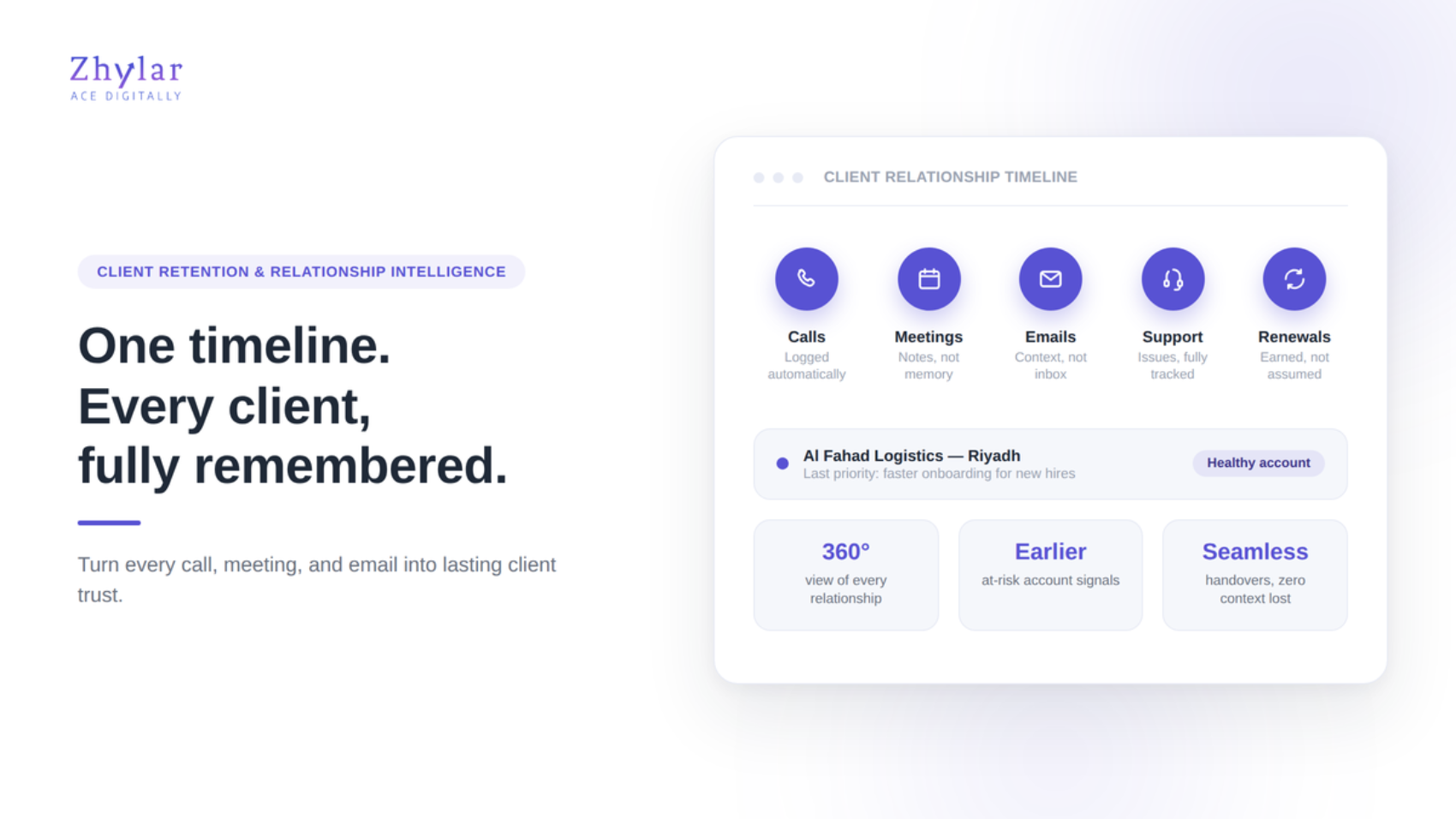
CRM platforms built around deep interaction intelligence are significantly changing the way customer success functions. By comparison to basic CRM tools that simply track contact records and deal stages, advanced CRM tools provide interaction timelines that enable CS Managers to see the entire arc of a customer’s relationship on a single scroll including all logged calls, all flagged commitments, and all tracked issues until resolved.
Additionally, advanced CRM tools automatically tag meeting notes with sentiment and topic information to identify potential frustration before it leads to a tipping point. Finally, advanced CRM tools facilitate the sharing of organisational context among employee teams, such that when a sales manager or implementation specialist or executive sponsor engages the customer, they have the same organisational context and do not start from scratch.
Whenever your CRM not only records what transpired during a client meeting, but also details its significance; such as any sentiments expressed regarding the meeting, what commitments were made to follow up on after the meeting and what priorities the client shared; you are creating an asset that can be called an “Organisational Memory” for your team.
The practical outcomes are significant:
- Seamless handovers: When an account manager transitions off a client, their successor receives a full history of the relationship (not a blank slate) to enable them to transition seamlessly into the new role.
- Proactive outreach: Examining interaction histories for patterns allows a team to determine the most appropriate time to contact the customer, well before the customer feels underappreciated or begins evaluating alternatives.
- Contextual upselling: Expansion conversations become natural progressions of ongoing dialogue, not awkward sales pitches, because they are rooted in the client’s own articulated goals.
- Personalised QBRs: Quarterly Business Reviews that use standard generic slide decks, evolves into a very customised discussion based on the customer’s unique experience, challenges and accomplishments.
In the GCC, where senior decision-makers expect to be engaged at a level commensurate with the size of the relationship, this depth of contextual intelligence is not a nice-to-have. It is a competitive differentiator.
Building a Client Retention Strategy for the GCC: Five Principles
For customer success leaders looking to strengthen their retention outcomes in the region, the following principles reflect what is working in the most competitive GCC markets right now.
- Centralise your relationship intelligence: Every client interaction, regardless of channel or team member should flow intoa single source of truth. By doing this, you eliminate the chance of institutional knowledge residing in individuals or in disconnected systems. As a starting point, define four required fields for every customer interaction logged in the system: [topic discussed], [commitment made], [customer’s next priority], and [health signal (positive, neutral or at-risk)]. Ensuring consistency during the data entry process will provide you a solid foundation on which to build your usage of these intelligence data at scale.
- Standardise interaction logging with a 48-hour rule: Create a standard format for documenting how you record meetings, calls, and support escalations for every customer. Cultivating a culture of logging touchpoints within 48 hours createsa common understanding of what happened during those interactions and makes it possible for team members to refer to accurate information to improve service levels to their customers. Creating a discipline regarding how to capture information during these meetings or calls will ultimately determine the quality of the interaction history.
- Train your team to mine context before every touchpoint: The five minutes spent reviewing a client’s interaction history prior to a call is worth more than any scripted talking points. Make contextual preparedness a part of your culture rather than anadditional option. When onboarding new members of your Customer Service (CS) team, include a live ‘context review’ session using real, anonymised account histories to instil this habit before they ever pick up a phone.
- Build early warning systems into your CRM: Declining engagement, missed milestones, unresolved issues, and changes in the stakeholders who are involved with an account are all signs that the relationship is at risk. Leveraging interaction data is key foridentifying these signs before they result in a client disengaging or technically churning. Consistently monitor accounts where the gap between touchpoints exceeds 30% greater than the frequency you have agreed on for the touchpoints; silence is frequently the first and most conspicuous sign of a lack of engagement.
- Measure and communicate Relationship ROI to the whole business.it will make it easier to secure funding for retention initiatives that are presently having difficulty doing so. Creating a robust foundation to clearlydemonstrate how employer-driven customer success positively impacts net revenue retention (NRR), increases referral business, and generates long-term growth of existing accounts; and presents this framework on a quarterly basis to both sales’ leadership and product, not just the CS team. When every function understands what a retained client is worth over a three-year horizon, the entire organisation starts behaving as if retention is its responsibility.
The Next Frontier: AI, Automation, and the GCC’s Evolving CS Landscape
The rules of client retention are not static, and the most forward-thinking CS teams in the GCC are already preparing for the next wave of change.
Artificial Intelligence will change how we document and utilize interaction history. Using AI-enabled meeting summaries, you can extract commitments, action items, and sentiment feedback from calls automatically, so there’s less manual logging of data, resulting in the quality of your data being more consistent throughout large CS teams. Also, predictive churn models based on patterns of interaction frequency, subject matter changes, and stakeholder engagement give CS leaders foresight into accounts that require attention weeks prior to the client having any issues with them.
At the same time, the GCC’s macro environment is creating new pressures and opportunities. Saudi Arabia’s Vision 2030 has been accelerating the professionalisation of procurement processes across both the public and private sectors, which raises expectations around vendor accountability and how structured relationships are governed. Digital-first enterprises, particularly in fintech, healthtech, and logistics, are entering the market with high service expectations and low tolerance for generic account management. And as the GCC’s SaaS ecosystem matures, consolidation within the mid-market vendors has reached an all-time high, meaning that retaining clients is an essential strategy for companies looking to grow as well as survive.
The CS teams that will lead in this environment are those that build interaction intelligence infrastructure today — so that when AI-assisted tools, automated health scoring, and predictive engagement models become standard, they have the high-quality relationship data those systems require to function effectively. The investment in structured logging of customer interactions is not just for improving the quality of conversations today, but also to build the data necessary to train the AI that will drive their retention strategy in the future.
The Competitive Advantage You Cannot Outsource
In a GCC market where competitors are often offering comparable products at comparable prices, the quality of the client relationship has emerged as the prime battleground for companies competing against each other. Companies willing to invest in developing the infrastructure for relationship intelligence by capturing all significant interactions that can be activated intelligently via their history and providing a consistent human experience across multiple scales, have built a true barrier to entry that is genuinely difficult to replicate.
The necessary tools are available to execute this today, as every client interaction by your team already generates valuable data. The critical question is, does your organisation capture and structure that data and have systems in place to harvest and utilise that data for all functions in the business (not just CS) that impact the client relationship?
The new rules of client retention in the GCC are not about working harder. They are about working with greater intelligence, greater continuity, and a deeper commitment to making every client feel known. This is the essence of Relationship ROI and defines the distinction between teams who retain and grow their client base and teams forever in search of new clients.
Frequently Asked Questions (FAQs)
1. Why is client retention becoming more important in the GCC market?
As the competitiveness of the GCC markets across industries steadily increases and customer acquisition costs are on the rise, client retention is becoming increasingly important. Clients who retain customers dramatically improve their overall customer lifetime value, have stronger customer referrals, continue to do business with them repetitively, and generate more stable and predictable long-term revenue growth.
2. What is Relationship ROI in customer success?
Relationship ROI is the quantifiable and measurable value created through developing a strong relationship with its customers based on long-term engagement and retention, trust, and customer loyalty instead of short-term sales statistics. Businesses can leverage relationship ROI to develop a customer lifetime value (CLV) and build a business with sustainable long-term growth.
3. How does personalization improve customer retention?
Personalization helps customers feel valued and understood. When businesses remember previous interactions, preferences, and concerns, they help to make customers feel valued and understood, and when they demonstrate this consistency in their communications, they enhance trust, ultimately increase customer satisfaction, and help establish long-term loyalty.
4. Why is interaction history important for customer success?
Interaction history provides teams with the complete picture of previous conversations, follow-up activities, customer preferences, and any outstanding inquiries. Business can thus use interaction history to reduce duplicate communication with customers, improve the quality of their responses to inquiries, maintain continuity across teams, and provide customers with a better, more human-like service at scale.
5. How can businesses improve customer retention at scale?
Businesses can improve retention by centralizing customer data, automating follow-ups, tracking engagement patterns, and maintaining proactive communication. The goal is to combine operational efficiency with personalized relationship management to deliver consistent customer experiences as the business grows.
6. What are the biggest causes of customer churn in competitive markets?
Common causes of customer churn include slow response times, inconsistent communication, poor follow-ups, fragmented customer information, and lack of personalization. Even small operational gaps can weaken trust over time and encourage customers to switch to competitors.
7. How does proactive customer engagement help businessesretainclients?
Proactive engagement helps businesses identify customer concerns before they escalate into larger problems. Regular follow-ups, personalized communication, and early intervention improve customer satisfaction and strengthen loyalty, reducing the risk of churn in highly competitive GCC industries.