
Modernizing Brokerages: Beyond the Spreadsheet in Dubai Real Estate

With a development speed that’s unrivalled by almost all other global cities, Dubai’s real estate market is getting more attention than ever before. New off-plan launches sell out in hours, investor appetite spans every continent, and a single high-profile project can generate thousands of inbound leads in a single weekend. Yet, you can still find many real estate agencies using the same tool for the last twenty years, the good old spreadsheet. 

For many years, a spreadsheet was good enough for many businesses as it handled contacts, phone calls, and helped agents gain a rough sense of who was interested in what. But Dubai real estate in 2026 isn’t the market it was in 2016, tools that are used for the real estate business should keep up with the current demands and trends. This is where property technology and especially modern real estate CRM systems come into play. Modern CRM systems are reshaping how brokerages operate, compete, and close deals. 

Why the Spreadsheet Era Is Ending 

Spreadsheets were never designed to handle lead management in real time and in high volume. They are static, they don’t refresh in real time on all devices, and they do not have the concept of urgency. When a new off-plan tower in the Dubai Marina or Business Bay opens for registration, a brokerage may receive hundreds of inquiries on WhatsApp, property portals, social media banners, and even walk-ins in just a few minutes. A spreadsheet cannot inform an agent the moment that there is a hot lead. A spreadsheet cannot show that a lead has viewed a payment plan three times within the hour. It cannot notify the sales manager of which agent still has an inquiry from two hours ago. 

The result is straightforward: leads turn cold, follow-ups are missed, and brokerages lose sales not because of poor properties, but because their internal processes are unable to keep up with buyer behaviour. Given the strong competition in the Dubai real estate market, this is a costly gap. 

The Off-Plan Challenge: Speed Is Everything 

Dubai has a large volume of off-plan property sales which is showing uniqueness in the buying behaviour of the investors. Investors from overseas regions are expecting response instantly because they are operating in different time zones. Even a delay of a few hours can mean a buyer has turned to another broker or another property. For the off-plan marketing sales management is not just about organizing all the data, but acting on it before the time runs out. 

This is where property technology platforms which are designed specifically for real estate come into play. A purpose-built real estate CRM understands the nuances of off-plan sales: unit inventory that changes by the hour, payment plan variations, developer incentives, and the need to route a lead to the right agent based on language, location, or project specialization, all within seconds of that lead arriving. 

Mobile-First Isn’t a Buzzword — It’s a Requirement 

The most successful agents in Dubai do not spend their time behind a desk. Instead, they attend property viewings, meet clients, and attend sales launches. If a brokerage’s systems only function properly on a desktop back at the office, agents could miss out on essential information when they need it most. 

With the implementation of a mobile interface, the situation will change dramatically. Agents will be able to record the contact information of the client on-site, and the information will be registered correctly. They will also be able to call the lead before they even leave the building. Managers can see pipeline movement from anywhere, without waiting for someone to update a spreadsheet at the end of the day. Notifications for high-intent leads like someone requesting a callback, someone downloading a brochure, someone re-visiting a listing arrive instantly on a phone, not buried in an inbox. 

In the case of a mobile-first approach, such access is more than just a nice-to-have. It is a necessity in an environment like Dubai, where the real estate field is very competitive with top deals. 

What Modern Real Estate CRM Software Actually Solves 

When assessing real estate technology, brokerages might want to focus less on “software” and more on the specific challenges that are to be solved. There are some challenges that appear to be particularly relevant in the case of Dubai: 

Lead Response Time

The most important factor in converting sales in off-plan projects is the instant and immediate response of the agents. Lead routing system guarantees prompt and immediate assignment of inquiries to agents instead of spending time sorting through the inquiries. 

Lead Source Visibility

Considering the fact that inquiries come from many sources (such as property websites, advertisement campaigns or developer partnerships and referrals), it is crucial for brokerages to know which channels work and which don’t. While spreadsheets can help to store information about the source of the inquiry, they cannot help in understanding which source worked in practice.

With leads pouring in from property portals, paid social campaigns, developer partnerships, and referrals, brokerages need clarity on which channels actually convert. Spreadsheets can log a source field, but they can’t easily correlate source quality with closed deals over time. A proper CRM does this automatically, giving management real data to guide marketing spend. 

Pipeline Transparency

Sales managers need to know, at a glance, where every lead sits in the funnel, new, contacted, viewing scheduled, negotiating, closed, without chasing agents for updates. Moreover, this transparency allows the brokerage to remain safe when agents leave the company, because the history of the clients and message records will stay in business, not in the own phones of the agents. 

Automated Follow-Ups

Customers who plan to buy properties need several communications from the company before they can make a buying decision. For example, they need to receive brochures and payment plan options. Such automating of the process ensures that no potential customer is missed just because an agent is busy dealing with a walk-in customer.

Compliance and Documentation

The regulatory situation with real estate in Dubai is complex and is managed by authorities like the Dubai Land Department and RERA, which means that it is important for a brokerage to have correct records of sales and communications with customers. A digital system is a great solution to help keep records in an organized way, so audits and compliance checks are far less painful than reconstructing history from scattered spreadsheets and message threads.

The Competitive Advantage of Getting This Right 

Brokerages that adopt modern property technology are more effective, not just faster. Agents spend less time entering information manually and instead use that time in actually engaging with the clients. Furthermore, management can see how the brokerage is performing in real time and not just at the end of the week. Also, rather than simply creating a series of spreadsheets that only one person can understand, the brokerage is creating a real asset, a database of leads and client data that anyone at the brokerage can use.  

In a market where developers routinely provide brokerages better access to available listings and more favourable deals for the majority of stages of the development process based on their sales performance and professionalism, having the operational backbone that enables quick closing is a competitive advantage. 

Making the Shift 

Transitioning away from spreadsheets doesn’t have to mean an overwhelming, all-at-once overhaul. Many brokerages start by digitizing their highest-value processes first, typically off-plan lead intake and follow-up, before expanding into full pipeline and post-sale management. The brokerages seeing the strongest results tend to prioritize a few things when choosing a platform: 

  • A real mobile-first interface that real estate agents will utilize while working out of the office 
  • An automated approach to lead generation and immediate lead assignment 
  • Immediate alerts related to the behaviour and urgency of potential buyers 
  • Clear reporting on lead sources, agent performance, and conversion rates 
  • Compliant tracking of records required by Dubai’s laws 

Brokerages that are enjoying success in Dubai’s rapidly changing property tech environment have learned that CRM is not just a software solution but the most important marketing tool they can use to close sales.  

Final Thoughts 

Dubai real estate isn’t slowing down, and neither are buyer expectations. The brokerages that continue to rely on spreadsheets and manual processes will keep losing ground to those equipped with real-time, mobile-first systems built specifically for high-velocity, off-plan-heavy markets. Modernization isn’t about chasing trends but about ensuring that the tools one uses will always correspond to the pace of the market. In a city where a launch can sell out before lunch, this idea of matching the technology one uses to the speed of the market helps separate the leaders from the followers in Dubai’s real estate market. 

Frequently Asked Questions (FAQs) 

1. Why are spreadsheets no longer effective for managing Dubai real estate leads?

Because spreadsheets are static and incapable of providing real-time updates, automatic alerts, and immediate lead routing, brokers often lose potential buyers to other brokers in the off-plan property market who provide quicker responses. 

2. What is off-plan lead management in real estate?  

Off-plan lead management pertains to the processes involved in generating leads regarding properties that are still being built or have not yet been launched. Efficient management of prospects in this type of property market is contingent primarily on timely and efficient prioritization of leads. 

3. How does a mobile-first CRM benefit real estate agents in Dubai?  

enables agents to immediately respond to leads that arise after showings, launch events, or meetings that they are involved in, eliminating the necessity to wait until they are back at the office to update records. This reduces response time and improves conversion rates. 

4. What features should a Dubai brokerage look for in real estate CRM software?

The necessary characteristics of such a system include automated distribution of leads, mobile accessibility, notifications in real time, monitoring the sources of information obtaining prospects, visibility of sales pipeline by the managers, and efficient reporting according to DLD and RERA standards. 

5. Does adopting property technology help with regulatory compliance in the UAE?

Yes. Digital platforms that log communication with clients and record transactions make it much easier for brokerages to keep records for compliance audits and regulatory reviews. 

6. Is it expensive for small or mid-sized brokerages to modernize their systems?

Many brokerages start with a phased approach, digitizing high-impact areas like off-plan lead intake before expanding further. This makes the transition manageable without requiring a complete overhaul on day one. 

7. How does technology improve lead source tracking for marketing decisions?

Modern systems ensure automatic matching of lead sources against actual conversions meaning that the management receives accurate data on the channels and campaigns that worked instead of relying on manual and error-prone count. 

8. What happens to client data when an agent leaves a brokerage?

With centralized digital systems, all the information related to client history and communication remains with the brokerage rather than being tied to an individual agent’s personal devices or notes, protecting the business’s long-term relationships and data. 
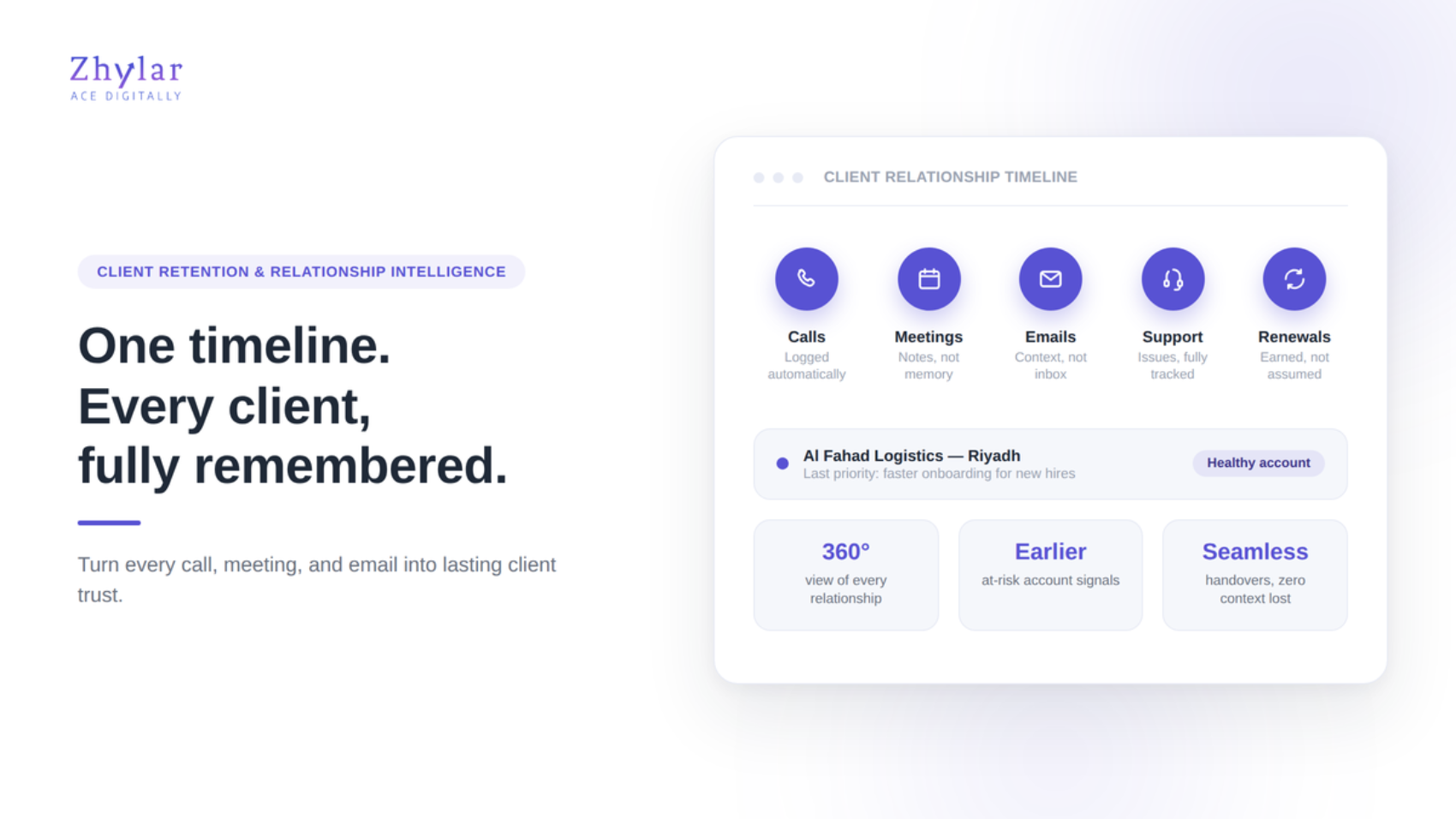
The New Rules of Client Retention in the GCC’s Competitive Landscape

In today’s Gulf Cooperation Council (GCC) markets, spanning the UAE, Saudi Arabia, Qatar, Kuwait, Bahrain, and Oman, client retention in the GCC is no longer a passive outcome of good service. It is an active, data-driven discipline that separates high-growth businesses from those quietly losing ground to competitors. 

The overall GCC has experienced a fundamental shift in its business landscape. Digital transformation initiatives, like Saudi Arabia’s Vision 2030 and the UAE’s National Innovation Strategy and the large amount of foreign direct investment flowing into the region, are changing the way B2B buyers view their businesses. The surge in enterprise SaaS adoption across sectors from fintech to logistics has raised the bar for what clients expect from the vendors and partners they choose. Entering into a contract is no longer the end of the process; it is the beginning of a long-term partnership that must be built on a solid foundation of trust and respect. 

The challenge for customer success professionals throughout the region is clear: how can you provide an authentic, genuinely personal experience to dozens or hundreds of customers at the same time, without sacrificing quality or consistency? 

The answer lies in what the most forward-thinking teams in the GCC are already doing: making interaction history the foundation of every client relationship. 

Why Client Retention in the GCC Demands a Different Playbook 

The GCC is not a monolithic market. It is a mosaic of cultures, industries, regulatory environments, and business expectations. Relationships here carry immense weight. In markets like Saudi Arabia and the UAE, trust is currency, and trust is built through memory, consistency, and demonstrated understanding. 

A client in Riyadh who mentioned a digital transformation initiative six months ago expects you to remember that. A procurement lead in Dubai who raised a concern about service delivery in Q2 will notice if you fail to follow up on it in Q4. These are not small oversights. In high-stakes B2B relationships, forgetting feels like indifference, and indifference accelerates churn. 

Typically, traditional customer success practices utilize individual account managers to help maintain and create what we call ‘institutional memory’. However, this approach has issues, like imperfect human memory, team changes, and when a relationship manager leaves an account, all institutional knowledge leaves with them. This creates a broken experience that clients suffer from immediately, in a region where senior level decision-makers share information with each other, one broken relationship has the ability to close doors for that organization. 

This is precisely why the new rules of client retention in the GCC are built around systematic relationship intelligence, capturing, storing, and activating every meaningful client interaction so the organisation, not just the individual, remembers. 

The blind spot most CS leaders miss: is their assumption that major breakdowns are the primary drivers of churn in the GCC when, in fact, it’s the cumulative impact of numerous small memory lapses. Missed context, repeated questions, and generic outreach signal to clients, all of which send the message to the customer that they don’t actually know/are completely unaware of their customer. That signal, compounded over time, makes switching feel justified. 

The Relationship ROI Framework: Retention as a Revenue Strategy 

In the GCC, customer success leaders are in greater demand to justify their role in commercial terms. Hence, a focus on relationship ROI has emerged as a measurable indication of the returns from investing in client relationships over time. 

Relationship ROI includes more than just renewals. It includes: 

  • Net Revenue Retention (NRR): Have your current clients increased their spend with you over time? 
  • Churn Rate Reduction: How are you identifying and intervening on accounts at risk before it’s too late? 
  • Time-to-Value (TTV): Have your clients realised the value of your product/service faster due to your proactive support? 
  • Advocacy and Referral Rate: Are satisfied clients becoming active promoters within their networks? 

All these metrics are strongly dependent upon the quality of client interactions and utilizing those interactions effectively over time. In the GCC, where referral business and professional networks are such strong influences in B2B business, the advocacy element of relationship ROI should be of particular focus. 

When your client feels truly known and understood by your team, they will not only renew but also refer, advocate, and expand their relationship with you. That is what the compounding effect of relationship intelligence can achieve when applied at scale. 

The relationship ROI conversation should include all areas of the business. Interaction intelligence that extends past the customer success (CS) function and informs sales growth conversations, confirms product roadmap priorities, and provides executive account sponsors with an understanding of account health supports all go-to-market activities creating greater collaboration in every department and making the entire organization more capable of responding to competitive pressure, creating a more fit-for-purpose overall business outcome. Retention is an overall business outcome, not just a customer success (CS) metric. 

Interaction History: The Hidden Asset Most Teams Are Leaving on the Table 

Each interaction that occurs between clients and companies – regardless of whether it is through emails, video calls, in person meetings, or support tickets – contains meaningful data. The data collected will include topics discussed as well as any concerns raised, decisions that were delayed, goals that were articulated, and frustrations expressed. Many businesses will collect this data on an informal basis in a variety of locations, such as email inboxes, call logs/notes (after the call occurs), and spreadsheets. 

This can create a fragmented view of the client relationship that is often inconsistent, incomplete and unavailable to anyone who was not physically present in the same room as the client when the conversation occurred. 

The GCC market is being disrupted by customer success teams that are changing this entire model by taking the data collected during customer interactions and creating a formal, structured, searchable and actionable asset. By systematically tracking and connecting customer touchpoints, such as notes from meetings, outcome summaries from calls, escalations of support, and feedback loops; Customer Success Managers can arrive at every meeting with a complete understanding of their client’s history. 

This changes everything about how the conversation begins. Instead of starting with “Can you remind me where we left off?”, your team opens with “Last quarter you mentioned that one of your bottlenecks was onboarding new team members so we have been developing something that will directly assist with that – can we show it to you?” 

That is not a small difference. For a client in a relationship-oriented market like the GCC, it is the difference between feeling like a ticket number and feeling like a valued partner. 

The Human Touch at Scale: Moving Beyond Personalisation Buzzwords 

“Personalisation” has become one of the most overused terms in customer success. In practice, it often means little more than addressing someone by their first name in an automated email. Clients, particularly in the GCC’s discerning B2B market see through this immediately. 

Genuine human connection at scale requires something more substantive: the ability to demonstrate continuity, context, and care across every touchpoint, regardless of which team member is handling the account. 

CRM platforms built around deep interaction intelligence are significantly changing the way customer success functions. By comparison to basic CRM tools that simply track contact records and deal stages, advanced CRM tools provide interaction timelines that enable CS Managers to see the entire arc of a customer’s relationship on a single scroll including all logged calls, all flagged commitments, and all tracked issues until resolved.

Additionally, advanced CRM tools automatically tag meeting notes with sentiment and topic information to identify potential frustration before it leads to a tipping point. Finally, advanced CRM tools facilitate the sharing of organisational context among employee teams, such that when a sales manager or implementation specialist or executive sponsor engages the customer, they have the same organisational context and do not start from scratch. 

Whenever your CRM not only records what transpired during a client meeting, but also details its significance; such as any sentiments expressed regarding the meeting, what commitments were made to follow up on after the meeting and what priorities the client shared; you are creating an asset that can be called an “Organisational Memory” for your team. 

The practical outcomes are significant: 

  • Seamless handovers: When an account manager transitions off a client, their successor receives a full history of the relationship (not a blank slate) to enable them to transition seamlessly into the new role. 
  • Proactive outreach: Examining interaction histories for patterns allows a team to determine the most appropriate time to contact the customer, well before the customer feels underappreciated or begins evaluating alternatives. 
  • Contextual upselling: Expansion conversations become natural progressions of ongoing dialogue, not awkward sales pitches, because they are rooted in the client’s own articulated goals. 
  • Personalised QBRs: Quarterly Business Reviews that use standard generic slide decks, evolves into a very customised discussion based on the customer’s unique experience, challenges and accomplishments. 

In the GCC, where senior decision-makers expect to be engaged at a level commensurate with the size of the relationship, this depth of contextual intelligence is not a nice-to-have. It is a competitive differentiator. 

Building a Client Retention Strategy for the GCC: Five Principles 

For customer success leaders looking to strengthen their retention outcomes in the region, the following principles reflect what is working in the most competitive GCC markets right now. 

  1. Centralise your relationship intelligence: Every client interaction, regardless of channel or team member should flow intoa single source of truth. By doing this, you eliminate the chance of institutional knowledge residing in individuals or in disconnected systems. As a starting point, define four required fields for every customer interaction logged in the system: [topic discussed], [commitment made], [customer’s next priority], and [health signal (positive, neutral or at-risk)]. Ensuring consistency during the data entry process will provide you a solid foundation on which to build your usage of these intelligence data at scale. 
  2. Standardise interaction logging with a 48-hour rule: Create a standard format for documenting how you record meetings, calls, and support escalations for every customer. Cultivating a culture of logging touchpoints within 48 hours createsa common understanding of what happened during those interactions and makes it possible for team members to refer to accurate information to improve service levels to their customers. Creating a discipline regarding how to capture information during these meetings or calls will ultimately determine the quality of the interaction history. 
  3. Train your team to mine context before every touchpoint: The five minutes spent reviewing a client’s interaction history prior to a call is worth more than any scripted talking points. Make contextual preparedness a part of your culture rather than anadditional option. When onboarding new members of your Customer Service (CS) team, include a live ‘context review’ session using real, anonymised account histories to instil this habit before they ever pick up a phone. 
  4. Build early warning systems into your CRM: Declining engagement, missed milestones, unresolved issues, and changes in the stakeholders who are involved with an account are all signs that the relationship is at risk. Leveraging interaction data is key foridentifying these signs before they result in a client disengaging or technically churning. Consistently monitor accounts where the gap between touchpoints exceeds 30% greater than the frequency you have agreed on for the touchpoints; silence is frequently the first and most conspicuous sign of a lack of engagement.  
  5. Measure and communicate Relationship ROI to the whole business.it will make it easier to secure funding for retention initiatives that are presently having difficulty doing so. Creating a robust foundation to clearlydemonstrate how employer-driven customer success positively impacts net revenue retention (NRR), increases referral business, and generates long-term growth of existing accounts; and presents this framework on a quarterly basis to both sales’ leadership and product, not just the CS team. When every function understands what a retained client is worth over a three-year horizon, the entire organisation starts behaving as if retention is its responsibility. 

The Next Frontier: AI, Automation, and the GCC’s Evolving CS Landscape 

The rules of client retention are not static, and the most forward-thinking CS teams in the GCC are already preparing for the next wave of change. 

Artificial Intelligence will change how we document and utilize interaction history. Using AI-enabled meeting summaries, you can extract commitments, action items, and sentiment feedback from calls automatically, so there’s less manual logging of data, resulting in the quality of your data being more consistent throughout large CS teams. Also, predictive churn models based on patterns of interaction frequency, subject matter changes, and stakeholder engagement give CS leaders foresight into accounts that require attention weeks prior to the client having any issues with them. 

At the same time, the GCC’s macro environment is creating new pressures and opportunities. Saudi Arabia’s Vision 2030 has been accelerating the professionalisation of procurement processes across both the public and private sectors, which raises expectations around vendor accountability and how structured relationships are governed. Digital-first enterprises, particularly in fintech, healthtech, and logistics, are entering the market with high service expectations and low tolerance for generic account management. And as the GCC’s SaaS ecosystem matures, consolidation within the mid-market vendors has reached an all-time high, meaning that retaining clients is an essential strategy for companies looking to grow as well as survive. 

The CS teams that will lead in this environment are those that build interaction intelligence infrastructure today — so that when AI-assisted tools, automated health scoring, and predictive engagement models become standard, they have the high-quality relationship data those systems require to function effectively. The investment in structured logging of customer interactions is not just for improving the quality of conversations today, but also to build the data necessary to train the AI that will drive their retention strategy in the future. 

The Competitive Advantage You Cannot Outsource 

In a GCC market where competitors are often offering comparable products at comparable prices, the quality of the client relationship has emerged as the prime battleground for companies competing against each other. Companies willing to invest in developing the infrastructure for relationship intelligence by capturing all significant interactions that can be activated intelligently via their history and providing a consistent human experience across multiple scales, have built a true barrier to entry that is genuinely difficult to replicate. 

The necessary tools are available to execute this today, as every client interaction by your team already generates valuable data. The critical question is, does your organisation capture and structure that data and have systems in place to harvest and utilise that data for all functions in the business (not just CS) that impact the client relationship? 

The new rules of client retention in the GCC are not about working harder. They are about working with greater intelligence, greater continuity, and a deeper commitment to making every client feel known. This is the essence of Relationship ROI and defines the distinction between teams who retain and grow their client base and teams forever in search of new clients. 

Frequently Asked Questions (FAQs) 

1. Why is client retention becoming more important in the GCC market?

As the competitiveness of the GCC markets across industries steadily increases and customer acquisition costs are on the rise, client retention is becoming increasingly important. Clients who retain customers dramatically improve their overall customer lifetime value, have stronger customer referrals, continue to do business with them repetitively, and generate more stable and predictable long-term revenue growth. 

2. What is Relationship ROI in customer success?

Relationship ROI is the quantifiable and measurable value created through developing a strong relationship with its customers based on long-term engagement and retention, trust, and customer loyalty instead of short-term sales statistics. Businesses can leverage relationship ROI to develop a customer lifetime value (CLV) and build a business with sustainable long-term growth. 

3. How does personalization improve customer retention?

Personalization helps customers feel valued and understood. When businesses remember previous interactions, preferences, and concerns, they help to make customers feel valued and understood, and when they demonstrate this consistency in their communications, they enhance trust, ultimately increase customer satisfaction, and help establish long-term loyalty. 

4. Why is interaction history important for customer success?

Interaction history provides teams with the complete picture of previous conversations, follow-up activities, customer preferences, and any outstanding inquiries. Business can thus use interaction history to reduce duplicate communication with customers, improve the quality of their responses to inquiries, maintain continuity across teams, and provide customers with a better, more human-like service at scale. 

5. How can businesses improve customer retention at scale?

Businesses can improve retention by centralizing customer data, automating follow-ups, tracking engagement patterns, and maintaining proactive communication. The goal is to combine operational efficiency with personalized relationship management to deliver consistent customer experiences as the business grows. 

6. What are the biggest causes of customer churn in competitive markets?

Common causes of customer churn include slow response times, inconsistent communication, poor follow-ups, fragmented customer information, and lack of personalization. Even small operational gaps can weaken trust over time and encourage customers to switch to competitors. 

7. How does proactive customer engagement help businessesretainclients? 

Proactive engagement helps businesses identify customer concerns before they escalate into larger problems. Regular follow-ups, personalized communication, and early intervention improve customer satisfaction and strengthen loyalty, reducing the risk of churn in highly competitive GCC industries. 

Companies

What is a Company?

A company is a business or organization you engage with. Companies can be clients, partners, or prospects, forming the backbone of your CRM.

Features of a Company at Zhylar

  • Stores all company details (industry, size, location)
  • Tracks all interactions and documents

Company List View

  • Log in to Zhylar
  • Go to Left-hand navigation panel
  • Go to Company

Here, you can find a list of all the companies added to the system.

Viewing a Company Profile

To view the details of any company,

  • Click any company name
  • See complete company overview
    • Basic information
    • Recent activities
    • Linked contacts/deals

Customer Type

  • A company is categorized as:
    • Existing: A customer you’re already dealing with.

Search Filter

  • Conduct a universal search across all fields through the search box.
  • Or search/sort through Name/Phone no./Email/Currency/Customer Type/Status.
  • Or, you can use the Filter button to filter your searches from a range of filters.

Managing Company Information

Adding New Companies

  • Click “+ New Company”
  • Fill out the data
  • Click “Save”

Also read about how to Import Companies on Zhylar.

Update Company Details

  • Click ⋮ 3 dots
  • Click on Update
  • Make changes
  • Company currency cannot be changed/updated.
  • Click “Save“.

Delete Company

  • Click ⋮ 3 dots
  • Select Delete
  • Provide confirmation.
  • The Company will be deleted successfully.

Company Details

  • Click on any company to open and view details.
  • Profile tab opens by default.
  • Check all details of the company, e.g., status, customer type, etc.
  • Click ✏️ Edit (yellow-highlighted pen) to edit details or invite customers directly.
  • Switch tabs to check data in specific modules, e.g., contacts, leads etc.

Managing Contacts

A contact is an individual person associated with a company. This person might be a decision-maker, buyer, or support staff. Your team communicates with them during business interactions.

View Contacts

Click Contacts tab

  • See all users added to the company
  • Conduct universal search or filter by fields

Adding a New Contact

  • Click “+ New Contact”
  • Fill required data.
  • Click “Save.”

Update Contact

  • Click ⋮ 3 dots
  • Select Update
  • Make changes
  • Click Save.

Delete Contact

  • Delete: Click ⋮ 3 dots
  • Select Delete
  • Provide Confirmation.

Business Activities

Leads

  • Click Leads tab
  • View all potential opportunities
  • Click lead name for details
  • Conduct universal search or sort by fields in ascending or descending order.

Deals

  • Click Deals tab
  • See all active negotiations
  • Add New Deal:
    • Click “+ New Deal”
  • Fill required details.
  • Save deal.
  • Conduct universal search or sort by fields in ascending or descending order.

Quotes

  • Click Quotes tab
  • See all Quotes
  • Add New Quote:
    • Click “+ New Quote”
  • Fill required details.
  • Save as draft or save and send quote.
  • Conduct universal search or sort by fields in ascending or descending order.

Sales Orders

  • Click Sales Order tab
  • See all Sales Orders
  • Add New SO:
    • Click “+ New Sales Order”
  • Fill required details.
  • Save as draft or save and send quote.
  • Conduct universal search or sort by fields in ascending or descending order.

Invoice

  • Click Invoice tab
  • See all invoices
  • Add New Invoice:
    • Click “+ New Invoice”
  • Fill required details.
  • Save as draft or save and send invoice.
  • Conduct universal search or sort by fields in ascending or descending order.

Payments Received

  • Check financial transactions for this company.
  • Click on any payment document number to view all details.
  • Redirected to Invoice module.
  • Check all details for this invoice, timeline, notes, emails, etc.

Statement

Statement of accounts is a detailed summary of all financial transactions between a company and a customer. It covers a specific period and shows invoices, payments, credits, and the remaining balance.

You can email the statement to your client by clicking on Send Email.

Also Read

Web Forms

Import Contacts

Import Companies


Import Contacts

Contacts in a CRM system are individual people your business interacts with, such as customers, prospects, or partners. They store key details like name, phone number, email, and job title. Each contact is linked to companies (accounts), deals, and activities. This linkage allows your team to track every conversation and interaction in one place. It enhances better relationship management.

Importing Contacts to Zhylar Platform

  • Log in to Zhylar
  • Go to Left-hand navigation panel
  • Click on Companies
  • The Companies list view will open.
  • From the top-right hand corner, click ⋮ 3 dots beside +New Company
  • Select Import Contacts.
  • You will be taken to a new page.
  • Upload a file in .xlsx format with the details of your leads.
  • If file is not ready, Download Template File from the right-hand corner.
  • Fill out the data in the filed provided.
  • All fields marked in * are mandatory.
  • For some fields, entry can be punched manually.
  • For others, such as salutation, country and such, a drop-down arrow will be there. You can select one of the pre-filled values.
  • Once done, upload this file back in the space provided by clicking on the Upload File button.
  • Click Import Contacts.
  • Your Contacts will be added to the system.
  • Click on Go to All Contacts to go to Contact List View page.
  • You can now see this newly added company in the list view.
  • In case there is an error with the file upload, simply click Replace File and try again.

Once your Contacts have been imported, you can now proceed. Read about how to navigate through the Companies module at Zhylar.

Also Read

Web Forms

General Settings

Basic Terminologies


Import Companies

In Zhylar, importing customers allows you to bring all your existing customer data into one secure, centralised database. You can include names, contact details, purchase history, and account information. This data comes from external sources like spreadsheets, CSV files, or other software. This ensures your team has organised, up-to-date information to manage relationships effectively and deliver personalised service.

  • Log in to Zhylar
  • Go to Left-hand navigation panel
  • Click on Companies
  • The Companies list view will open.
  • From the top-right hand corner, click ⋮ 3 dots beside +New Company
  • Select Import Companies.
  • You will be taken to a new page.
  • Upload a file in .xlsx format with the details of your Companies.
  • If file is not ready, Download Template File from the right-hand corner.
  • Fill out the data in the filed provided.
  • All fields marked in * are mandatory.
  • For some fields, entry can be punched manually.
  • For others, such as country code, industry and such, a drop-down arrow will be there. You can select one of the pre-filled values.
  • Once done, upload this file back in the space provided.
  • Click Import Companies.
  • Your Companies will be added to the system.
  • Click on Go to All Companies to go to Company List View page.
  • You can now see this newly added company in the list view.
  • In case there is an error with the file upload, simply click Replace File and try again.

Once your Companies have been imported, you can now proceed. Read about how to navigate through the Companies module at Zhylar.

Also Read

Web Forms

General Settings

Basic Terminologies


Import Items

In Zhylar, importing items lets you quickly add your complete product or service catalogue. This includes item names, descriptions, prices, tax details, and units of measurement. You can import from external sources like spreadsheets or CSV files into a centralised inventory. This streamlines sales processes, ensures accuracy, and makes it easier for your team to create quotes, orders, and invoices.

Importing Leads is a quick way to add leads in bulk whilst avoiding any errors.

  • Log in to Zhylar
  • Go to Left-hand navigation panel
  • Click on Items
  • The Items list view will open.
  • From the top-right hand corner, click ⋮ 3 dots beside Filters
  • Select Import Items.
  • You will be taken to a new page.
  • Upload a file in .xlsx format with the details of your leads.
  • If file is not ready, Download Template File from the right-hand corner.
  • Fill out the data in the filed provided.
  • All fields marked in * are mandatory.
  • Once done, upload this file back in the space provided.
  • Click Import Items.
  • Your Items will be added to the system.
  • From here, click on Go to Item Master to go to the Items module.
  • The imported item will be reflected in the Item List View.
  • In case there is an error with the file upload, simply click Replace File and try again.

Once your Items have been imported, you can now proceed. Read about how to navigate through the Items module at Zhylar.

Also Read

Web Forms

General Settings

Basic Terminologies


Items

Items are the products or services your company offers, serving as the core components for quotes and sale. In Zhylar CPQ system, they include configurable options, with each item having a unique SKU and pricing.

  • Central product catalog
  • Custom configurations
  • Pricing and UOM management

Items List View

  • Log in to Zhylar
  • Go to the left-hand navigation panel
  • Click on Items
  • Complete list of all items added
  • Search and filter options
  • Click “+ New Item”
  • Fill required data
  • Add Primary UOM and Secondary UOM (refer section below).
  • Click “Save Item”
  • Primary UOM: Main measurement unit (mandatory)
  • Secondary UOM: Alternative units (optional)
    • Click on the check box for “Add Secondary UOM”
    • E.g., a laptop could be sold by the piece (UOM- piece/pc) or in quantity if wholesale (UOM- box/bx)
    • Set conversion ratios (E.g., 1 box = x laptop pieces)
    • Remove when not needed

To add items in bulk directly to Zhylar system, refer to the article on Import Items.

  • To migrate items from Zhylar to your device;
  • Click ⋮ 3 dots
  • Select Export Items.
  • Items will be downloaded in excel format directly to your device
  • An item can be marked active or inactive.
  • To mark an item inactive, toggle to inactive status.
  • Ensure the item is not associated with any other module. If so, you will receive an error message.

To view the details of an item

  • Click ⋮ 3 dots
  • Select View.
  • A side sheet will open up with all the item details.

To update an item

  • Click ⋮ 3 dots
  • Select Update.
  • Make required changes.
  • Click Save.

You must ensure an item is not associated with any modules. If so, item cannot be deleted.

  • To delete an item;
  • Click ⋮ 3 dots
  • Click on Delete.
  • Confirm deletion.
  • The item will be deleted from the system.
  • If item is associated with some modules, you will receive an error message.
  • Make required changes to proceed.

Filter and Search

  • Use search bar for quick access
  • Filter by category/type or other fields
  • Clear filters to reset view

Also Read

Units of Measurement

General Settings

Currencies


Recent Transactions

Recent transactions in Zhylar provide a quick view of an item’s latest activity. They show when, how, and at what price it was quoted or sold. They also show to whom it was sold. It tracks usage across quotes, sales orders, invoices, and even lost deals. This offers a 360-degree picture of the item’s sales history.

  • Log in to Zhylar
  • Move to Deal/Quote/SO/Invoice tab.
  • Add New or open existing quote via update option.
  • For new Quote, after adding item Click on Recent Transactions.
  • A side sheet will open.
  • The entire transaction history will be fetched.

Filter search to obtain best results:

  • Via company

Tick the box to view transactions against that organization only.

  • Via module
  • Via document status

Recent transactions will show the following detail for each transaction.

To simply view the item details,

  • Click on Details.
  • The details of the item will be visible to you.

Units of Measurement (UOM)

UOM or Units of Measurement refers to standardized units like kilograms, liters, or hours used to quantify products or services. It ensures accurate pricing, quoting, and inventory tracking across the CRM. UOMs are customizable to match specific business needs, making transactions more precise and consistent.

  • Log in to Zhylar.
  • Go to Left-hand panel
  • Click on Configuration
  • Under Masters, click on UOMs
  • Check the list of UOMs added to the system.
  • Click + New UOM
  • Enter details
  • Code: Enter a code for the UOM
  • Name: Give the UOM a name
  • Duplicate UOM names or codes are not allowed. In case you enter a duplicate name or code, you will receive an error.
  • Click Save

Update UOM

  • Click ⋮ 3 dots > Update → Edit → Save
  • Toggle UOM status from active to inactive.
  • Click Save
  • Click ⋮ 3 dots > select Delete
  • Type “DELETE” to provide confirmation.
  • The UOM will be deleted.
  • If the UOM is associated with any items, you will receive an error message

Also Read

Units of Measurement

General Settings

Currencies


Payment Terms

Payment terms are the agreed-upon conditions between a buyer and a seller. These terms specify how and when payment should be made. They define due dates, applicable discounts, penalties for late payments, or instalment plans.

In a CRM system, these terms are integrated into quotes, sales orders, and invoices. This integration helps streamline and standardize the payment process.

  • Log in to Zhylar.
  • Go to Left-hand panel
  • Click on Configuration
  • Under Masters, click on Payment Terms
  • Check the list of Payment Terms added to the system.
  • Click + New Payment Term
  • Enter details
  • Name- Name of payment term.
  • Days- The number of days within which payment term must be satisfied.
  • Toggle “Make Default” if needed.
  • Default payment terms are auto-applied to documents.
  • Click Save
  • Click ⋮ > Update
  • Make changes
  • Save

Please note

  • For quotes, payment terms is for reference purpose only. The expiry date has no implication on payment terms.
  • Global Use: Consistent payment policies
  • Click ⋮ > Select Delete
  • Type “DELETE” to provide confirmation.
  • Payment term will be deleted.
  • If Payment Term is associated with some other modules, e.g., Quotes, then it cannot be deleted.
  • You will receive an error message.
  • Delete relevant document first to proceed with deleting the payment term.

Also Read