
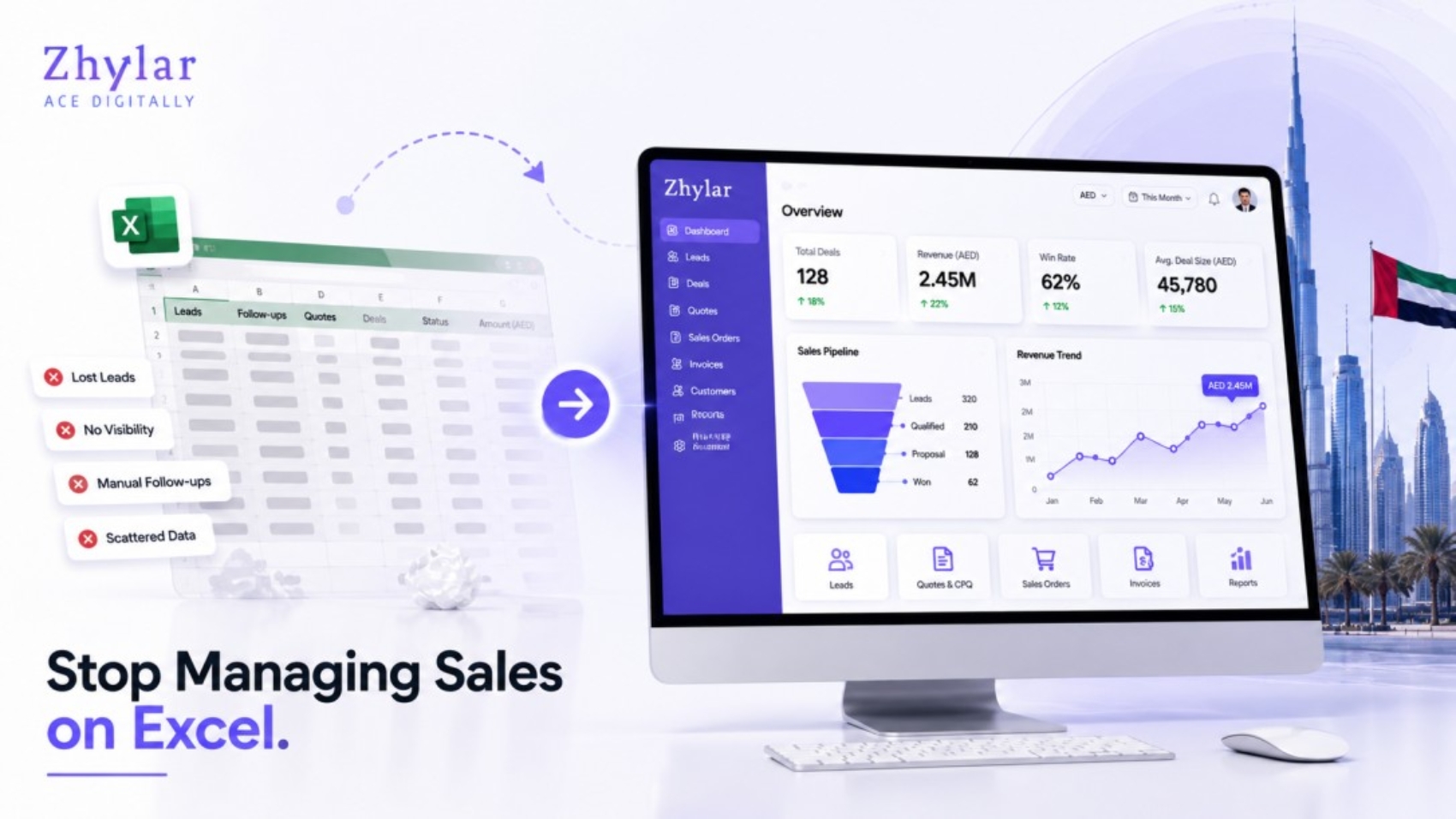
The UAE’s SME Engine Is Outgrowing Its Spreadsheets
Small and medium enterprises are the backbone of the UAE economy. They make up the overwhelming majority of registered businesses in the country and generate more than half of non-oil GDP, according to figures regularly cited by UAE government economic bodies. This information may seem like just a statistic but it depicts the whole importance of the problem we are discussing. But when such a large segment of the economy relies on a system that was designed to run its sales operations on a tool built for static numbers rather than dynamic customer relationships, the inefficiency isn’t a private inconvenience. It’s a drag on one of the country’s core growth engines.
Focusing on the details shows that the same phenomenon occurs in office after office, including a growing trading company based in Dubai, a real estate agency located in Abu Dhabi, and a logistics firm from Sharjah- all running their operations through Excel spreadsheets. Though this system seems to work when there are only three people in the team and about twenty leads. It starts to break somewhere between ten leads a week and a hundred, and by the time leadership notices, the business has usually already been quietly bleeding revenue for months.
This is one of the common and completely ignored reasons why companies in the UAE can’t enter the growth stage. Not due to not having enough demand, not having a bad product but a sales process held together by tabs, formulas, and whichever file happens to be the “real” one that week.
The Blind Spot: Excel Fails Silently
Here’s the part that rarely gets said out loud: spreadsheets don’t fail loudly. There’s no alert when a hot lead goes cold. No flag when two salespeople are chasing the same account without knowing it. No system nudging anyone toward a follow-up. The pipeline just sits there, technically “tracked,” while opportunities quietly expire in a forgotten row.
This is the real blind spot, not that Excel lacks features, but that its failures are invisible until the damage is already done. A promising inquiry can sit untouched for a month, and nobody finds out until a competitor closes the deal first. The cost doesn’t show up as a dramatic incident. It shows up months later, as a quarter that underperforms for reasons nobody can quite pin down.
Excel vs. CRM: A Side-by-Side Look
| Function | Excel / Spreadsheets | Dedicated CRM Platform |
| Lead follow-up | Manual; relies on someone remembering | Automated reminders and ownership assignment |
| Data accuracy | Multiple versions, manual entry errors | Single shared source of truth, real-time updates |
| Reporting | Manually rebuilt, often days out of date | Live dashboards updated as deals move |
| Access control | Anyone with the file sees everything | Role-based permissions and activity logs |
| Collaboration | Overwritten cells, version conflicts | Simultaneous multi-user editing without conflict |
| Compliance readiness | No audit trail, no consent tracking | Built-in data access logs and consent records |
| Scalability | Breaks down past ~50-100 active leads | Scales with lead volume and team size |
The pattern across every row is the same: Excel requires human discipline to compensate for what it structurally lacks. A CRM builds that discipline into the system itself.
Where the Real Cost Lives: Version Conflicts and Reporting Lag
“Sales_Tracker_Final_v3_ACTUAL_FINAL.xlsx” is a joke in most offices because it’s also painfully true. The moment a second salesperson joins, version conflicts become inevitable , someone emails a copy, edits it locally, and now two “current” versions of the truth exist simultaneously. In UAE markets known for speed, retail, real estate, trading, that internal friction translates directly into missed opportunities.
Reporting suffers the same way. Ask a spreadsheet-run sales team for a clean read on conversion rate by lead source, or average deal size by industry, and watch the scramble begin filtering tabs, cross-referencing, hoping the underlying data is even current. By the time that report reaches a founder or sales director, it’s often a week or two stale. Decisions end up resting on gut feeling rather than live numbers, simply because getting an accurate one takes too long to be useful.
The Compliance Mechanism Most Businesses Miss
This is where the relationship between the tools employed and regulations needs to be made clear. The UAE Personal Data Protection Law (PDPL) mandates businesses to be in a position to demonstrate their control over the process of gathering, using, and holding customer data, including being able to report the identification of those who have been able to access the records in question, if so needed.
A spreadsheet is not able to provide that kind of information. There are no access logs showing who made changes in the contacts last week. There is no systematic approach needed to satisfy information requests or erase data. A CRM allows addressing this problem by providing full records of all the access events and the changes made, and narrowing down access to sensitive data only to those who are absolved to see the personal information. The advantage of compliance is not abstract, it shows the very nature of such support as it happens.
Breaking the Silo: Sales Data Doesn’t Live Alone
Although seldom regarded as part of the entire business process, sales tracking has a role to play. For example, in the UAE, B2B and B2G transactions are now taking advantage of a new e-invoicing legislation that ensures that the sales process is integrated with finance and taxation compliance. Once a sale has been recorded in a spreadsheet, a member of the accounting or invoicing department will still have to enter the same information again leading to a variety of problems that invariably arise during the re-entry process.
The introduction of connected CRM solutions will eliminate the reason for multiple data re-entries. Closed deals flow into invoicing workflows, and marketing can see which lead sources actually convert rather than guessing.
The customer service link is no less tangible than the others and gets overlooked just as frequently. When a support ticket comes from a spreadsheet-managed sales operation, the agent who has that ticket will usually have no idea of any details about a customer’s purchase or of the promises made before the sale, or whether there is an ongoing renewal at that moment- in that case, the required context would be stored in the spreadsheet of another person, if it was stored at all. This results in customers repeating information they had provided before, while the resolution time becomes unnecessarily longer due to the missing data transfer. With sales and service data in one system, a support agent opens a ticket and immediately sees the full account history: purchase details, prior conversations, and any commitments made during the sales process. That’s not a convenience feature, it directly affects retention, since repeat customers in relationship-driven UAE markets tend to judge a business by how well it remembers them, not just how well it sold to them the first time.
Once sales data resides in an integrated solution instead of an isolated file, the organization moves away from a collection of departments exchanging spreadsheets and towards a unified system model.
What’s Coming Next and Why It Matters Now
Three shifts are converging that make this less of a “someday” decision and more of a “soon” one:
- Regulatory tightening: The implementation of PDPL is expected to follow the pattern of regulations seen in other countries introducing business data protection rules which see periods of grace and then compliance checks and penalties.
- E-invoicing digitization: The introduction of compulsory electronic invoicing by the UAE tax authorities will present businesses utilizing legacy systems with numerous obstacles in adapting to the new requirements.
- AI-driven sales intelligence: The practice of lead scoring, next action determination, and predicting the sales pipeline is becoming mainstream capabilities of the CRM software which won’t be possible using simple spreadsheets as they require formally structured information with continuous updates.
Businesses that migrate now aren’t just fixing today’s inefficiencies, they’re positioning themselves to adopt these capabilities as they become competitive necessities rather than nice-to-haves.
From Fixing Problems to Unlocking Growth
It would be easy to stop at “spreadsheets are risky, so switch.” But the more useful framing is what becomes possible once sales data is centralized, automated, and trustworthy.
- Sales departments can expand without proportional growth of personnel. Automated follow-ups and lead routing allow a team of five to manage the workload previously requiring eight people.
- Growth into new emirates or free zones can be better organized as all team members are working on the same live pipeline irrespective of where they are located instead of having emailed copies of files.
- Forecasting becomes a genuine planning tool instead of a guess because reports carry real data and not a snapshot put together a few days ago.
- Customer trust can be viewed as a competitive advantage and not as a compliance requirement as organizations can show how customer data is secured and processed.
Making the Shift: What a Migration Actually Looks Like
Moving away from Excel doesn’t have to mean a disruptive overnight cutover. A practical path looks like this:
- Baseline your current numbers first, conversion rate, average response time to new leads, and current pipeline value, so you can measure the impact of the switch rather than assume it.
- Migrate in two distinct batches, not one. Import your active deals first so that your sales team can get started right away. Postpone the closed deals that are connected to revenues until they have been cleared from an accounting point of view, accounting records have lots of dependencies concerning financial audits, and importing them together with all the rest at once is the main reason for all sorts of errors during the migration process.
- Run a 30-day parallel period where the sales team will be using the new CRM system as the main one and the spreadsheets as the backup., to build confidence before fully retiring the old system.
- Design permission tiers around data sensitivity, not job title. Fields like trade license numbers, payment terms, or Emirates ID details should be restricted to roles with a genuine compliance need mirroring how PDPL distinguishes ordinary contact data from more sensitive personal data categories, rather than granting blanket visibility by default.
- Name a data custodian before go-live. PDPL implicitly expects an accountable owner for customer data. Most CRM platforms let you assign this role during setup, but it’s a step businesses frequently skip and the one most worth doing deliberately rather than defaulting to “whoever’s an admin.”
The businesses that treat this as a structured transition, rather than a reactive scramble after a lost deal, tend to see the smoothest adoption and the fastest return.
Excel got many of these businesses off the ground, and there’s no shame in that. But a sales function generating real revenue needs infrastructure built for relationships and accountability, not a static file that happens to have customer names in it. The businesses that make that shift deliberately, on their own timeline, tend to be the ones setting the pace in their sector rather than reacting to whoever gets there first.
Frequently Asked Questions (FAQs)
1. How long does it take to migrate sales data from Excel to a CRM?
For the majority of small and medium-sized enterprises in the UAE, the process of transitioning sales data from Excel to a CRM solution can be wrapped up either in days or within a period extending to a couple of weeks, provided that certain procedures were followed like running transfers in batches, starting with active deals.
2. Will my sales team need extensive training to switch to a CRM?
Most modern CRM solutions have intuitive interfaces, and thus sales personnel are able to get the hang of this new solution within the first week of operating the software routinely, particularly in the case of running a pilot period simultaneously with the new CRM solution.
3. Can a CRM integrate with tools we already use, like WhatsApp, email, or invoicing software?
Yes, most CRM platforms support integrations with common communication channels, accounting tools, and marketing systems, allowing sales data to flow into other departments automatically.
4. Is a CRM more expensive than continuing to use Excel?
Although Excel may seem free, the hidden price of lost opportunities, time spent reconciling spreadsheets, and the need to enter the same data multiple times usually eclipses the cost of a CRM in only a short time.
5. What happens to our existing Excel data when we switch to a CRM?
Existing spreadsheet data can typically be imported directly into a CRM, preserving lead history, contact details, and deal records without starting from scratch.
6. Can small and medium UAE businesses realistically afford a CRM?
There are numerous CRM platforms available at affordable prices tailored specifically for SMEs that allow even small sales teams to transition smoothly.
7. How does a CRM help with UAE compliance requirements like the PDPL?
CRMs provide structured data storage, role-based access permissions, and activity logs, giving businesses the audit trail needed to demonstrate how customer data is accessed, used, and protected.
8. What is the typical return on investment when switching from Excel to a CRM?
Return on investment can be achieved by companies thanks to minimized number of untracked leads, increased speed of following up and more precise forecasts. This will happen during the first two to three sales cycles.