
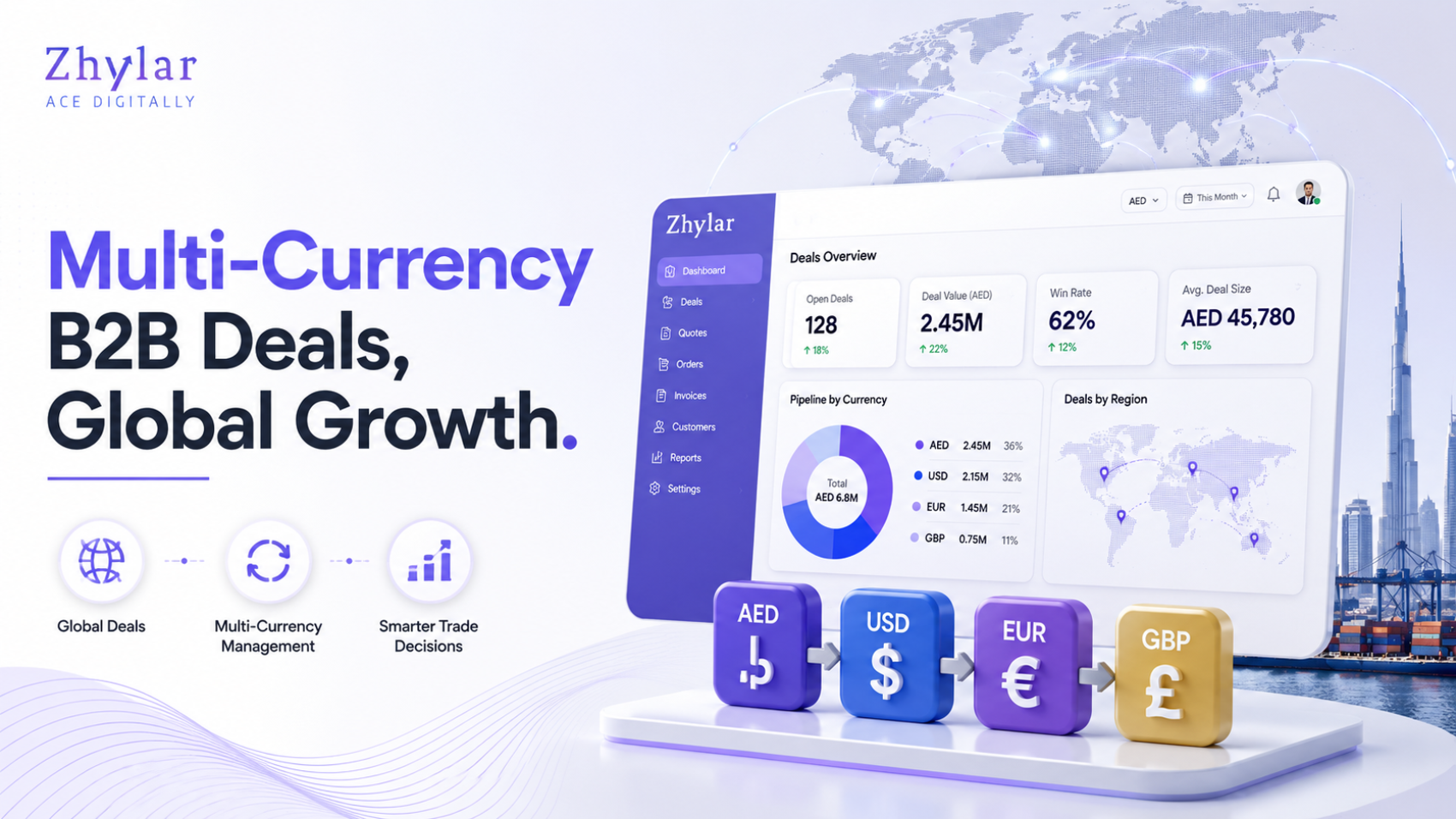
2025 saw the non-oil foreign trade of the UAE crossing the AED 3.8 trillion mark ($1.03 trillion), a surge by 27% compared to 2024 statistics. However, in addition to the announced gains, there’s less known but equally crucial fact: practically no transaction is carried out in one currency. A Dubai distributor who states prices to an EU manufacturer in EUR, bills a customer from Saudi Arabia in USD, and pays its suppliers in AED is a typical case for a place like the UAE: that’s just a regular day.
This is a reality of performing multi-currency transactions in the trade world: currency conversion becomes an integral part of the deal during almost all phases, including quoting, invoicing, tax reporting, and reconciliation. While being inches away from requiring structured e-invoicing in 2026-2027, the UAE countries have firms doing AED/USD/EUR conversions in a manual way and eventually losing profit because of imprudent mistakes in currency conversion who risk being caught in compliance traps.
Why Multi-Currency Operations Matter More Than Ever
Successfully assuming a role as a trade hub means positioning oneself at the crossroads of different currency regions. The UAE links Asia, Europe, and Africa to trade routes, and the Comprehensive Economic Partnership Agreements have elevated the UAE’s non-oil export performance, with a projected share of 21.6 percent of total non-oil trade by the end of 2025, the highest in the history of the country. This implies that many more SMEs are now taking part in B2B transactions that previously used to be the prerogative of large multinational companies with dedicated treasury teams.
However, these small and medium-sized companies often find themselves in a challenging situation, as they rely on traditional techniques and tools, such as Excel spreadsheets, templates and manual rate checks, for quoting in multiple currencies, which is far from being acceptable by treasury standards. The gap between complexity of deals involved and effectiveness of their operations is what causes all the risks.
The Blind Spot Most Businesses Miss: Currency Errors Are Compliance Errors, Not Just Margin Errors
Here’s the connection most multi-currency guides skip: a currency conversion mistake in a B2B quote isn’t purely a pricing problem, it’s a tax-reporting problem.
As per the VAT regulations in UAE, invoices should show taxable value in AED irrespective of whether they are issued in USD or EUR. In case the quotation is provided to a European client in EUR by the sales department at one exchange rate and afterward the finance department prepares an invoice by applying a different exchange rate for establishing taxable revenues in AED, it will create a discrepancy between both these documents, and this difference would reflect not only in relation to the client but will also impact VAT filings.
Now let’s consider a real-world example: A client raises questions over an invoice eight weeks following the execution of a contract in which he asks why the value in AED does not correspond with what was expected to be in EUR. If the exchange rate used at the quotations stage was not recorded in any manner, but was only “calculated” in the mind of a person issuing the quotation, or inside a cell of a spreadsheet that has since been overwritten, it becomes impossible for finance department to trace back the exchange rate to be applied and the exact moment when it was used as well as the reasons for its usage. This is not just an assumption but rather one of the most common mistakes made in international B2B disputes which is absolutely avoidable.
There is a major error here: organizations often see currency conversion as the responsibility of the sales team and VAT compliance as a responsibility of the finance department. But in reality these are two departments looking at the same data point. If the rate is obtained correctly at one point in time, it is recorded, saving both departments from potential problems. Get it wrong, and you’ve created a sales problem and a compliance problem from a single mistake.
The 2026–2027 Regulatory Shift Changes the Stakes
This blind spot is about to matter a lot more. The Ministry of Finance of the United Arab Emirates (UAE) is introducing a mandatory e-invoicing system based on the Peppol five-corner model in accordance with Ministerial Decisions Nos. 243 and 244 of 2025. The e-invoicing system uses structured XML invoices in PINT-AE format and transmits the invoices through an Accredited Service Provider (ASP) rather than in PDF or paper format.
The rollout timeline is phased:
- From July 2026: voluntary adoption begins, businesses can pilot the system with no penalty exposure.
- From January 2027: mandatory for large taxpayers with annual revenue of AED 50 million or more.
- From July 2027: mandatory for the remaining in-scope VAT-registered businesses, including most SMEs.
Instead of relying on manual currency reconciliation, structured e-invoicing allows invoices to be automatically validated against a standardized template. After using automated validation, businesses can discover whether the AED-equivalent value corresponds to the exchange rate logic, while making sure that automated processing works without a hitch. In this sense, now that it is possible to establish precise and traceable currency conversion while quoting, firms will easily adapt the process in time for the compulsory conversion, which will come into effect in 2027. Those who still carry out manual currency reconciliation will run the risk of being non-compliant by the deadline.
What Practitioner-Level Currency Management Actually Looks Like
Generic advice says “automate your exchange rates.” Practitioner-level management goes further:
- Distinguish the mid-market rate from the settlement rate. The rate a business uses to price a quote (often the mid-market or interbank rate) is rarely the rate a bank or payment processor applies at actual settlement, correspondent banking spreads typically add a percentage-point cost that erodes margin if it isn’t priced in advance. Quoting off the mid-market rate without accounting for this spread is a common, quietly expensive mistake.
- Lock the rate at the moment of quote issuance, not at invoicing. If a quote is issued on Monday and the client signs on Thursday, using Thursday’s rate to generate the invoice creates a mismatch with what the client actually agreed to on Monday. Rate-locking at issuance and recording that locked rate against the quote record, closes this gap and gives both sales and finance a single, defensible number.
- Treat exchange rate data as a shared, timestamped ledger, not a sales input. The rate applied to a quote needs to be visible to finance without re-entry, and traceable months later without anyone needing to remember which spreadsheet tab held it.
- Where volume justifies it, consider forward contracts for large recurring deals. For businesses with predictable, large-volume cross-border invoicing (e.g., a recurring EUR supplier payment), a forward contract locking a future exchange rate can remove volatility from margin planning entirely, step beyond spot-rate quoting that most SMEs haven’t yet adopted but larger trading houses use routinely.
Where an Integrated System Closes the Gap
This is the point where treating currency as a standalone task stops working. Rate accuracy, quote-to-invoice consistency, VAT-taxable value reporting, and e-invoicing readiness aren’t four separate problems, they’re four views of the same underlying data: which exchange rate was applied, to which deal, at which moment.
More and more companies in the trading sector are solving the problem by incorporating multi-currency logic into the CRM and quote creation process instead of applying currency conversion as an afterthought. In practice, this means:
- Lock rates at the moment of quoting so that any rate applied to a transaction will be fixed and stamped at the time of quote preparation and not recalculated later in the invoicing process.
- A persistent, timestamped rate ledger attached to every quote and invoice, so finance can reconstruct exactly which rate was used and when, without manual digging, months after the deal closed.
- AED-equivalent value calculated automatically alongside the foreign-currency quote, keeping the VAT-reportable value and the client-facing price permanently in sync.
- Export formats structured for compatibility with PINT-AE style e-invoicing, so businesses piloting the voluntary phase in 2026 aren’t rebuilding their quoting process from scratch under the 2027 deadline.
Framed this way, multi-currency management stops being a sales convenience and becomes what it actually is: the connective layer between sales, finance, and tax compliance in any business operating across AED, USD, and EUR.
The Opportunity, Not Just the Risk
It is easy to look at all of this defensively to prevent disputes, to stay away from penalties, to guard against margin leaks. However, the ones who are smart make the right decision and go on the offensive. The usage of instant multi-currency quotations permits deals to be finalized in no time as compared to competitors who are using more traditional methods relying on manual conversion of transactions. The possibility to track currency rates for the purpose of proper pricing creates credibility among those foreign clients who already have experience with poor invoicing practices. Hence, taking the necessary steps to adapt to the UAE imminent introduction of an e-invoicing system in advance can transform a compliance deadline of 2027 into early market entry in 2026.
With more small and medium-sized enterprises moving into cross-border trade and the UAE developing its regulatory framework around them, the importance of multi-currency exchange moves from back-office practice to a key growth driver. Companies who understand this will be the first to reap benefits within the hub’s next growth cycle.
Frequently Asked Questions (FAQs)
1. Why does a currency conversion error in a B2B quote also create a VAT compliance risk?
The invoices in the UAE should show the taxable amount in AED even if the transaction is executed in USD or EUR. If the rate of currency conversion mentioned in the quotation does not correlate with the rate of the invoice then the taxable amount in AED would officially appear incorrect and be recognized as an issue pertaining to tax reporting and not pricing issues.
2. What is the UAE’s e-invoicing mandate and when does it take effect?
Under Ministerial Decisions No. 243 and 244 of 2025, the UAE is rolling out mandatory structured e-invoicing (PINT-AE format, via an Accredited Service Provider) using a phased timeline: voluntary from July 2026, mandatory from January 2027 for companies with revenue over AED 50 million, and mandatory from July 2027 for all the VAT registered entities.
3. What’s the difference between the mid-market rate and the settlement rate in a B2B quote?
Mid-market rate refers to the reference exchange rate against which the quote is priced; settlement rate refers to the exchange rate used by the bank and payment processor to process payment which usually is a bit above the mid-market rate. If the quoting just relies upon the mid-market rate, then the profit margin may gradually go down.
4. Why should exchange rates be locked at the moment a quote is issued rather than at invoicing?
If the exchange rate is recalculated at invoicing instead of fixed at quote generation time, then the content of the invoice may differ from what has been agreed upon with the client, causing disputes and reconciliation issues that could arise due to the delay that may occur from the moment of quoting and signing the quote.
5. What should businesses do if a client disputes an exchange rate used months earlier?
Businesses need a timestamped record showing exactly which rate was applied to that specific quote and when. Without this audit trail, resolving the dispute becomes guesswork, which is why logging rate data at the point of quote creation matters.
6. Are forward contracts relevant for SMEs handling AED, USD, and EUR trade?
Forward contracts help companies dealing with a considerable number of cross-border payments in a specific currency to stabilize their currency exchange rates and reduce margin fluctuations. The utilization of forward contracts improves the process of currency exchange rate determination, which is becoming even more popular as the volume of trade among SMEs increases.
7. How does multi-currency quote accuracy affect deal-closing speed?
Accurate quotes in several currencies produced automatically help sales teams respond to international customers in a few minutes instead of hours, which allows them to minimize the waste of time usually caused by the need for manual looking up of currency exchange rates.
8. Should businesses prepare for e-invoicing before it becomes mandatory?
Yes. As the e-invoicing system in the UAE will become voluntary in July, 2026 and mandatory in 2027, companies adopting an innovative quoting and invoicing strategy now will not have to rush through e-invoicing system implementation soon, which is guaranteed to become very hectic.