
In 2025, the Federal Tax Authority (FTA) conducted about 176,000 inspections of the market, which is an 89% increase from the year before. This demonstrates clearly where we’re headed with regards to federal tax compliance enforcement in the UAE. It indicates a transition from less frequent spot-checking to more continuous and systemic oversight of the manner in which enterprises maintain and report their revenue. This represents a fundamental shift in the operational and regulatory landscape for all businesses registered for value-added tax (VAT) in the UAE and will undoubtedly remain unchanged.
For many businesses, though, the greatest risk is not the outcome of a deliberate failure to comply; rather, it is a subtle, structural compliance deficiency. The accounting department and the sales department typically have the same goal: to produce accurate financial information and to file taxes in a timely manner. Unfortunately, sales and accounting are typically operated in completely separate ways. Sales typically use a CRM to manage their data while accounting typically uses computerised systems such as QuickBooks or Zoho. As a result, much of the data that is moved between sales and accounting must be re-typed and, therefore, there can be many “duplicate” invoices and VAT numbers will tend to drift apart.
This gap isn’t just an operational inconvenience. In a market where the Federal Tax Authority (FTA) expects every dirham of output VAT to be traceable back to a real, verifiable transaction, a disconnected sales-to-accounting workflow is a direct threat to financial integrity and to VAT compliance. Therefore, closing this loop isn’t optional. It’s what is driving how modern businesses in the UAE will remain audit-ready, file accurate VAT returns and avoid a last-minute chaotic reconciliation that results in errors, penalties and sleepless nights prior to the FTA’s deadline.
The Hidden Cost of Disconnected Sales and Accounting Systems
When there is no communication between a Customer Relationship Management (CRM) and an accounting system, someone has to do the communication for the two systems. Typically, this means that a finance employee has to manually enter information on invoices, customer information, and information impacting Value Added Tax (VAT) on sales from the CRM into an accounting software system, for example, QuickBooks or Zoho Books, for each sale listed in the CRM.
The manual gap between each system creates three predictable issues:
- Duplicate or missing invoices- A sale that is closed in the CRM may not be accurately reflected in the accounting system or be entered into the accounting system a second time creating distortion of-eligible revenue.
- Mismatched VAT treatment- Employees in sales are not tax professionals. Therefore, a transaction that is to be zero-rated, exempt, or subject to the reverse charge mechanism can easily be entered incorrectly if it isn’t flagged consistently between systems.
- No single source of truth- When there are different reports of revenue based upon the sales in the CRM as opposed to how revenue shows in the books, finance spends countless hours (sometimes days) reconciling the two systems before they have a chance to file VAT.
None of this is a people problem. This is solely a systems issue. In the context of UAE VAT Compliance, this is a systems issue with real financial consequences.
Why UAE VAT Filing Leaves No Room for Sync Gaps
UAE VAT compliance is very strict with an unforgiving clock. Once a business is VAT registered (mandatory at AED 375,000 in annual taxable supplies, voluntary from AED 187,500) it will have to file a VAT return (Form VAT201) through the FTA’s EmaraTax portal and pay any VAT due to them within 28 days of the closing date of that business’s tax period. The majority of businesses will do this on a quarterly basis while businesses with an annual turnover greater than AED 150 million will be required to file monthly. The 28-day deadline for filing a VAT return or making a VAT payment will be the same whether or not there is VAT payable for that period; there is no exemption if there was “nothing to report”.
Miss that window, and the penalties are specific and immediate:
| Compliance event | Penalty |
| First late VAT201 filing | AED 1,000 |
| Repeat late filing (within 24 months) | AED 2,000 |
| Late VAT payment (under Cabinet Decision No. 129 of 2025, effective 14 April 2026) | 14% per annum, calculated monthly on the outstanding balance |
| E-invoicing non-compliance (Ministerial Decision No. 243 of 2025, mandatory from July 2026) | Up to AED 5,000 per breach |
It’s important to pay attention to how late payments work: this new late payment structure replaces an even tougher previous model (2% immediate, 4% after seven days, then 1% per day, capped at 300%) with a flat annualized rate. While still being flexible on the amount of time before penalties are incurred, this system has removed any cap on the amount charged so that for every day you do not make your payment the amount you owe continues to grow linearly until you finally do make your payment.
This is precisely where sales-to-accounting sync becomes a compliance issue, not just an efficiency one. A VAT201 return is only as accurate as the underlying sales data feeding it. If invoices generated in the CRM aren’t reconciled with the VAT ledger in QuickBooks or Zoho Books, finance teams risk reporting output VAT that doesn’t match actual sales activity, a significant discrepancy that will trigger an FTA audit of the organization, or may require preparation of a Voluntary Disclosure (Form VAT211) or may lead to incorrect return and subsequent re-filing of return.
And the expectations are even higher. Starting in July 2026, the UAE rollout of the EIS will add additional pressure to move away from quarterly summaries of invoice-level reporting to near-real-time reporting. For businesses that already have a strong, automated connection between their sales data and their accounting platform, adapting to this change will be much easier than for those that continue to rely on manual export and end-of-quarter scrambles.
What “Closing the Loop” Actually Means
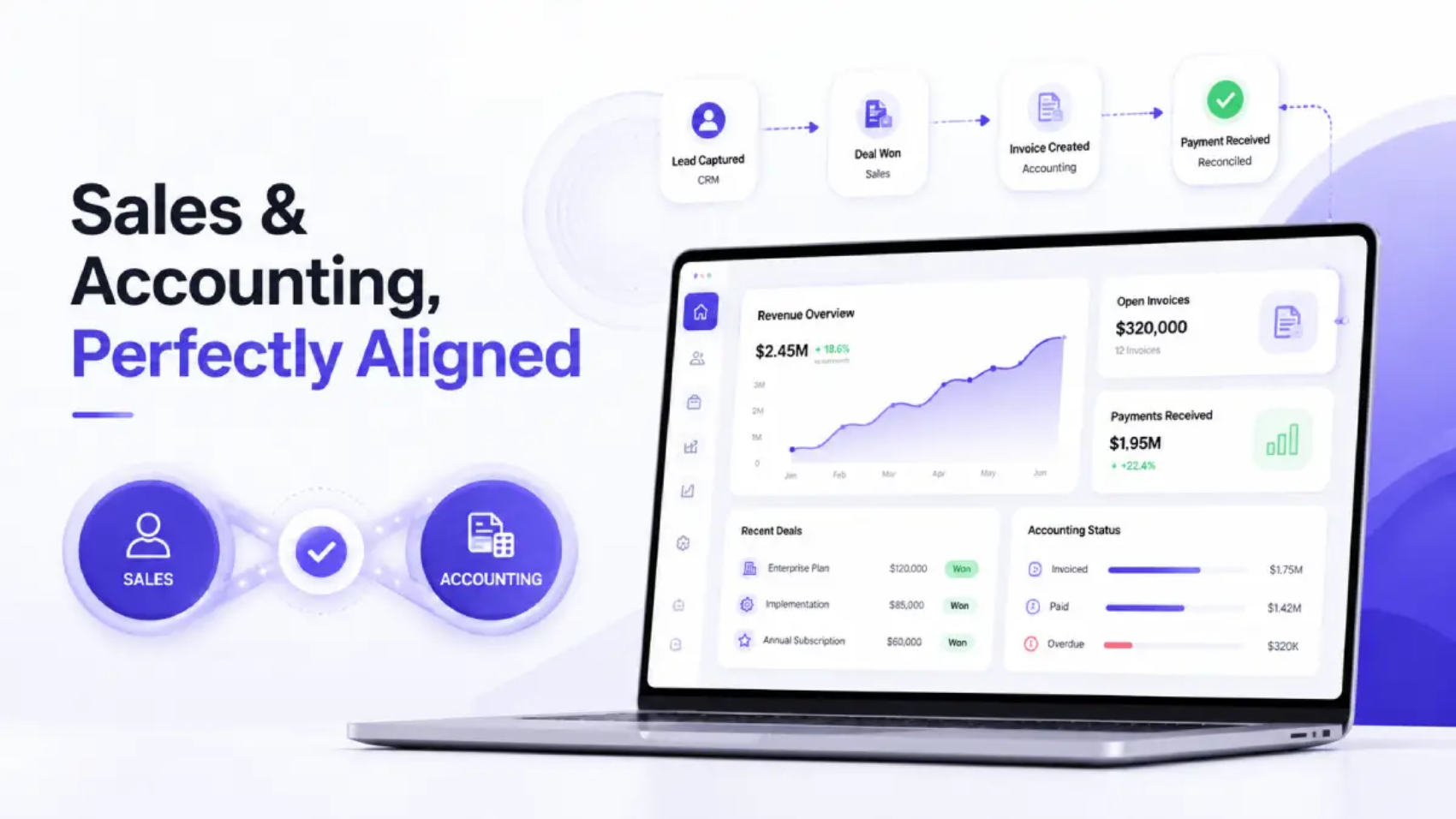
Closing the loop between sales and accounting isn’t about adding more spreadsheets or more checklists. It’s about designing a workflow where a sale, once recorded, flows through to the accounting system automatically — correctly tagged, correctly dated, and correctly mapped to the right VAT treatment, without anyone re-entering a single figure.
A genuinely synced workflow typically includes:
Real-time, two-way data flow: When a deal closes or an invoice is generated in the CRM, it should appear in QuickBooks or Zoho Books immediately, not at the end of the week when someone finally has time to update the books.
Consistent VAT coding at the point of sale: Standard-rated, zero-rated, and exempt transactions should be classified the same way in both systems, eliminating the guesswork that often happens during manual entry.
A traceable audit trail: Every invoice should be traceable from the original sales record through to the VAT return line it informed. This is invaluable not just for FTA audits, but for internal financial reviews and investor due diligence.
Automatic reconciliation, not manual matching: Instead of finance teams cross-checking CRM exports against accounting reports by hand, the two systems should already agree — because they were never allowed to drift apart in the first place.
This is exactly the gap that purpose-built CRM platforms with native QuickBooks and Zoho integrations are designed to close. Rather than treating the CRM as a sales-only tool and the accounting platform as a separate, disconnected system, the right setup treats them as two views into the same financial record — so that sales velocity and accounting accuracy stop working against each other.
Five Signs Your Sales-to-Accounting Sync Needs an Upgrade
If you experience any of the following, it is important to examine the flow of sales and accounting data between your systems:
- Finance often requests “the real numbers” from sales before they process the VAT return, as there is a misalignment between figures in the CRM and on the company accounts.
- Invoices are being created on two separate occasions – once when the sale takes place, and again when someone manually enters it into QuickBooks or Zoho Books.
- VAT coding is inconsistent, with similar transactions sometimes marked standard-rated and sometimes exempt, depending on who entered them.
- There is no clear audit trail connecting specific sales with specific lines on the filed VAT return.
- Reconciliation takes place quarterly in a rush rather than being an ongoing process during the reporting period.
Any one of these would indicate that the workflow between sales and accounting is primarily based on manual labour, rather than reliable syncing, and therefore presenting opportunities for errors in relation to VAT reporting.
Building a Compliance-First Sales-to-Accounting Workflow
The organisations that are able to handle the complexities of UAE VAT compliance most efficiently are not necessarily the organisations with the largest finance teams; instead they are the organisations whose systems are designed such that compliance occurs as a result of regular selling activity rather than being an independent, manual activity added afterwards.
In many cases this means selecting a CRM that not only stores contact information and deal status but also has built-in functionality for invoicing, VAT fields, and direct integration with accounting solutions like QuickBooks or Zoho Books. As a result of having a CRM built with this level of financial integrity, sales reps can generate compliant invoices without having to know how to code sales taxes, while simultaneously providing finance teams with already reconciling, VAT-coded, and audit-ready accounting records by the time the filing season arrives.
The result is a workflow where:
- Sales transactions automatically become accounting transactions without duplicate data entry.
- Transactions will be treated consistently for VAT purposes reducing the probability of misclassifying transactions.
- Finance teams will spend their time focused on reviewing exceptions rather than searching for inconsistencies.
- VAT 201 preparation will be a matter of exporting accurate amounts created previously rather than reconstructing the amounts from scratch.
The Road Ahead: E-Invoicing and Real-Time Compliance
The implementation of compulsory e-invoicing in the United Arab Emirates is an indication of how the VAT compliance landscape will be evolving, moving towards having less focus on retrospective account reconciliations and instead, placing greater emphasis on having system-level (real-time) accuracy.
Businesses who already have a closed loop between their CRM and their accounting software (i.e., QuickBooks, Zoho Books, etc.) will naturally be in a better position to comply with this change as they have a synchronisation that has been created with real-time accuracy rather than trying to retrofit a manual system to meet a new digital requirement.
Before Your Next VAT Filing: A Sync Readiness Check
Financial integrity isn’t a once-a-quarter event that happens right before a VAT deadline — it’s the cumulative result of every sale being recorded correctly, every invoice matching the right VAT treatment, and every figure in the accounting system tracing cleanly back to a real transaction in the CRM.
Don’t wait for the next filing cycle to find out where the gaps are. Run through this before your next VAT201 is due:
- Run a report of last quarter’s total CRM sales and compare it to the total VAT revenue in your accounting system. If those two reports do not match exactly, you do not have a rounding error; you have a system synchronization error.
- Select five invoices randomly from your recent invoice history. Follow the trail of each from your CRM through to the corresponding line on your VAT201. If there are any points on that trail where you have to manually search for information or create a spreadsheet; that is another area of potential risk in your process.
- Ensure that the VAT treatment (standard rated, zero rated, exempt or reverse charge) has been consistently applied between similar transactions of different sales persons.
- Ask finance how many hours were spent reconciling CRM against accounting for last quarter. Any time that was spent on reconciling these systems is therefore lost to reviewing rather than simply entering data.
- Confirm whether the current systems are capable of supporting invoice level reporting prior to e-invoicing mandate in the UAE taking effect (July 2026).
If any of these expose a gap, the fix isn’t more checklists or more headcount in finance — it’s choosing a CRM that treats invoicing, VAT coding, and direct QuickBooks or Zoho Books synchronization as core functionality, not an add-on. It is important to remember that the FTA conducted 176,000 inspections in 2025 and that number will only continue to increase. The businesses that are least exposed to inspections will not have the most amount of paperwork but will have sales and accounting systems that are in agreement prior to any inspection being conducted. Businesses that successfully comply with UAE VAT have done so by no longer treating sales to accounting synchronization as an IT function, and have treated it as core compliance infrastructure which is built in from the first invoice rather than patched in prior to any audits.
Frequently Asked Questions
1. How often do UAE businesses need to file VAT returns?
The frequency of filing for VAT Returns is established by the Federal Tax Authority. For example, most businesses registered for VAT and have a yearly revenue of less than AED 150 million will generally have to file on a quarterly basis. If your business has more than AED 150 Million in annual revenue or has a more complicated transaction structure, then you will have to file on a monthly basis. The exact period will be available on EmaraTax.
2. What is the deadline for filing a VAT return in the UAE?
You must submit your VAT returns (Form VAT201) and pay any associated amounts owed within 28 days after the end of the tax period. This applies whether or not there is any VAT due; you must file your zero return on time.
3. What happens if my CRM sales totals don’t match my accounting system’s VAT figures?
A mismatch means the VAT201 you file may not reflect actual sales activity, which can lead to an inaccurate return, an FTA inquiry, or the need to submit a Voluntary Disclosure to correct it later. The earlier the gap is found and reconciled, the less disruptive it is — discovering it during a filing crunch or an audit is far costlier than catching it through continuous sync.
4. What penalties apply for late VAT filing or late payment in the UAE?
If your filing is not completed on time, you will incur a late filing fee of AED 1,000 for the first offence and AED 2,000 for any second offence that occurs within 24 months from the date of the first offence. In addition to this penalty, you will incur a charge of 14% on any amount remaining due from the date of the late payment until it is paid, based on a yearly charge divided up into 12 monthly instalments, as per Cabinet Decision No. 129 dated 14 April 2026. Both penalties will occur regardless of whether you committed the error intentionally or otherwise.
5. Do I need to integrate my CRM with QuickBooks or Zoho Books, or can manual exports work?
Exporting data manually can allow the numbers to be moved between accounting systems; however, it also introduces the same exact risks (duplicate invoices, inconsistent VAT codes, delayed visibility) which direct integration is designed to avoid. Also, as transaction volume increases, most VAT filing mistakes occur due to manual handoff.
6. What is a Voluntary Disclosure, and when do I need to file one?
A Voluntary Disclosure (Form VAT211) is a formal notice from a business to the FTA that an error has occurred on a previously filed VAT return, as opposed to waiting for the FTA to discover it via selection for review or audit. Generally speaking, if the error is disclosed proactively by the business, the return will be viewed more favorably than if the discrepancy was identified through an inspection.
7. How does the UAE’s upcoming e-invoicing mandate affect VAT compliance?
Starting in July 2026, all businesses must use the UAE’s Electronic Invoice System (EIS) as part of the mandatory rollout under Ministerial Decision No. 243 of 2025. Fines for non-compliance can be as high as AED 5,000 per violation. This will change the way invoices are reported to be more like real time reporting. Businesses with automated sales-to-accounting processes will need to change very little in their processes compared to businesses that still use manual processes.
8. What’s the difference between standard-rated, zero-rated, and exempt VAT transactions?
Standard-rated supplies are subject to VAT at the prevailing VAT rate in the UAE. Zero-rated supplies (e.g. certain types of export) are also subject to VAT but at a 0% VAT rate, which means that an entity can recover the underlying input VAT. Exempt supplies are not subject to the VAT regime, meaning there is no VAT charged on the sale of the good/service nor is the buyer allowed to recover their input VAT. One of the most common errors in filing a VAT return is incorrectly classifying supplies based on VAT treatment.
9. Does my business need to register for VAT in the UAE?
The registration threshold for VAT in the UAE is based on annual taxable supplies. If annual taxable supplies exceed AED 375,000, it becomes mandatory to register. If annual taxable supplies are greater than AED 187,500, it is optional to voluntarily register (i.e., the entity can, but is not required to). Generally speaking, businesses below the AED 187,500 threshold do not have to register for VAT but will want to monitor their taxable supply levels closely as they approach either threshold.
10. Can sales-to-accounting sync reduce risk during an FTA audit?
Yes, absolutely. Implementing sales-to-accounting syncs can greatly reduce exposure and risk of an unfavourable outcome during an FTA audit. The primary question for an auditor performing an FTA audit is whether the VAT figures reported have corresponding evidence of a real, verifiable transaction. When there are sales-to-accounting syncs implemented in the business, the auditor has the ability to follow an unbroken trail of evidence that existed prior to the audit notice, thereby eliminating the finance team from having to create a source of evidence for all transactions subject to the FTA audit in response to the audit notice.