
The UAE’s business landscape is evolving fast, and if you’re an SME owner, you’re probably feeling it.
A rapidly changing regulatory environment, significant pressure to digitalize at a fast pace, fluctuation in customer expectations, and an uncertain global macroeconomic environment.
It’s no longer enough to “keep up.” You need to see what’s coming before it hits you.
That’s exactly what the 2026 UAE SME Growth Report reveals: businesses that are growing today aren’t just working harder, they’re making smarter, data-backed decisions.
The key to this transformation is real-time visibility to data on an organization’s operations.
Understanding the UAE SME Landscape in 2026
SMEs remain the backbone of the UAE economy. But the environment they operate in has changed significantly.

Three major forces are driving this transformation:
- Regulatory evolution (VAT, corporate tax, e-invoicing readiness)
- Digital acceleration across industries
- Customer demand for quicker, more personalized and transparent service
Because of this shift towards more complex business operating environments, many SMEs will find it difficult to continue with existing growth models. To optimize growth, businesses must combine operational improvements with core competency development and strategic foresight.
Key Economic Shifts Impacting SMEs
Compliance Is Becoming More Complex
With the corporate tax regimes now in force and mandatory e-invoicing being phased in under FTA regulations; small and medium enterprises must take steps to ensure that their records are accurate and produced in real-time.
What does this mean for you?
- Late filings can result in penalties
- Manual tracking increases compliance risk
- Disconnected systems create data inconsistencies
Businesses are migrating towards systems that are ready for compliance in the UAE, VAT-enabled accounting software for the UAE and integrated systems that reduce the reliance on manual processes.
Cash Flow Is Under Tighter Scrutiny
While total SME financing from UAE banks reached AED 28 billion in 2023, lenders and investors are taking a more conservative approach to evaluating new lending opportunities. Small and medium enterprises must exhibit a greater level of financial discipline.
Some of key trends that we are seeing:
- There is an increased focus on cash flow forecasting by SMEs in the UAE.
- There is an increased demand for real-time financial reporting by SMEs in the UAE.
- There is an increased dependence on automated invoicing solutions by SMEs in the UAE.
Late payments, poor or no visibility and inaccurate forecasts are no longer going to be accepted risks for businesses seeking financing or investor interest.
Digital Transformation Is No Longer Optional
In 2026, digital maturity directly correlates with business performance.
SMEs adopting cloud-based business software UAE, CRM software UAE for SMEs, and ERP solutions UAE SMEs are:
- Making quicker decisions
- Decreasing operational costs
- Retaining customers better
Companies that still use spreadsheets and non-integrated systems are experiencing a decline in their market position.
Customer Expectations Are Evolving Rapidly
Customers now expect:
- Faster responses
- Personalized interactions
- Seamless service across channels
To fulfill these higher customer expectations businesses have embraced CRM marketing automation solutions, customer data platform, and integrated communication tools.
Companies that fail to meet these expectations will lose a considerable percentage of market share, even when their underlying product is strong.
Data-Driven Decision-Making Is Becoming the Norm
The most important change has come from how decisions are being made.
Previously, decisions were made based on experience and gut feeling,
And now, decisions are based on real-time analytics UAE SMEs, dashboards, and predictive insights
This change has changed the way leaders run their organisation within the SME sector and widening the gap between businesses that have visibility and those that don’t.
The Hidden Risk: “Blind” Decision-Making
The most common obstacle SMEs encounter isn’t a lack of data. It’s operating without full visibility into what that data means in real time.
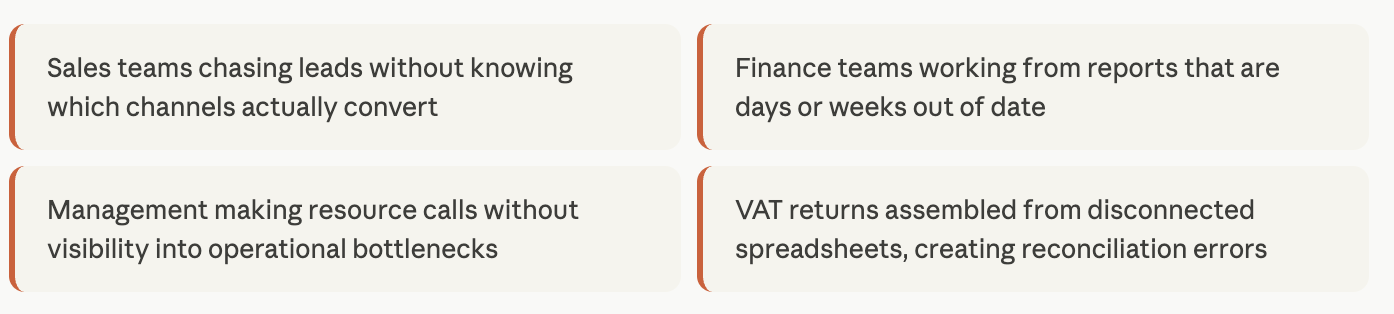
This creates what can be called “blind spots” in business operations.
The solution isn’t more data, it’s better visibility and integration. The goal is to connect the systems that you already have so that information flows automatically and decisions can be made based on current facts rather than recent memory.
How Real-Time Data Visibility Changes the Game
Modern SMEs are increasingly investing in systems that host real-time dashboards, allow for unification of data, and support instantaneous report generation.
Here’s how automated invoice reconciliation works when your ERP, CRM, and VAT return module are connected, solving one of the most time-consuming compliance problems for product-selling SMEs in the UAE.
With the right solutions integrated into daily workflows, businesses can do the following:
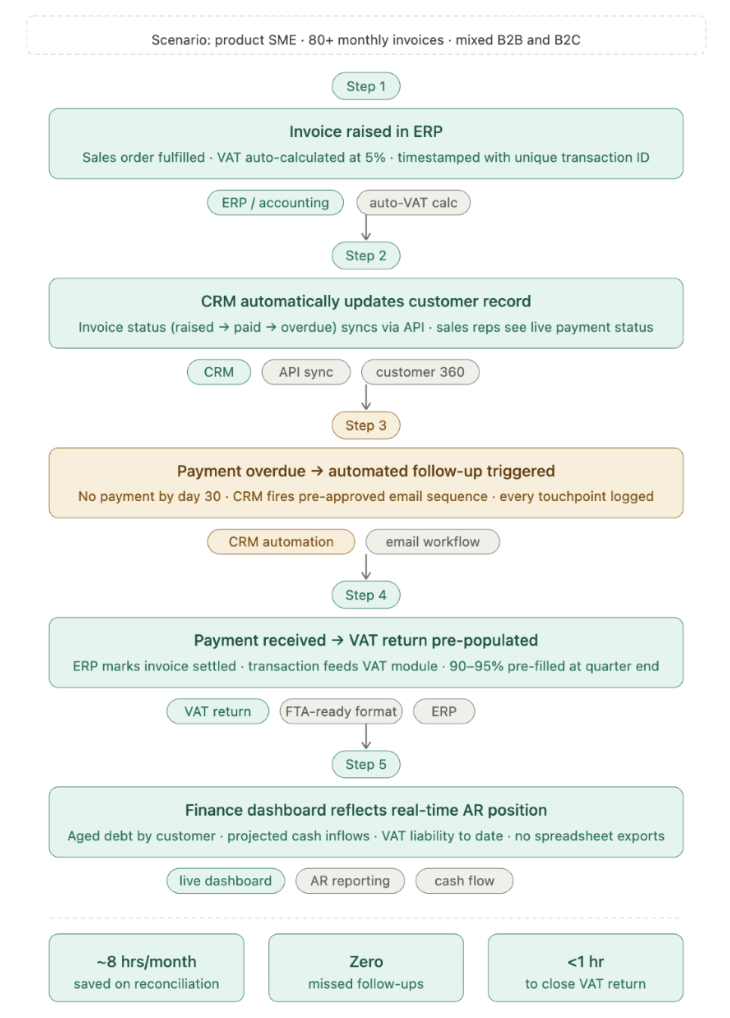
The integration will not only save time — but it will remove an entire category of human error from your compliance chain.
This transition to a proactive way of making decisions has been the key differentiator between fast-growing and stagnant SMEs.
Role of a Technology Partner
Integrating your systems like this usually means finding a partner who has experience implementing ERP and CRM systems in the UAE. This is someone who knows how your firm’s chart of accounts will be affected by FTA e-invoicing regulations, and how to set up a CRM to ERP integration so that data flows seamlessly without manual intervention. The right partner reduces the amount of risk associated with implementing a system and is often the difference between a system that works on day one and one that requires six months of troubleshooting. SMEs don’t have to navigate this alone.
Strategic Pillars for SME Growth in 2026
To successfully navigate through economic shifts, SMEs must build capability across five interconnected areas. The following order of development is most suitable based on most SMEs in the UAE:
- To establish financial visibility first
- Then, integrate CRM
- Finally, include automation into operations
This is because each level is built on the data quality that was created in the previous level.
Financial Visibility and Control
Investing in accounting software UAE SMEs and real-time reporting tools ensures:
- Generating accurate forecasts
- Faster compliance
- Better financial planning
For most SMEs in the UAE, this is the first integration they should consider as accurate financial data is a prerequisite for all the other systems. If you do not have accurate financial data to work from, then cash flow forecasts and VAT reconciliation remains manual.
Integrated Technology Ecosystems
Disconnected systems slow down business operations.
The process of integrating ERP-CRM Systems is the most important structural layer that makes the above-mentioned scenario possible and will be the basis for all the future automation that will follow. It is also important to note that the order of integration is also important: accounting first, then CRM, then workflow automation on top.
Customer-Centric Growth
The ability to deliver exceptional customer experience will be a major key to growth in 2026.
Using CRM marketing automation integration, businesses can:
- Personalize communication
- Improve lead nurturing
- Increase retention rates
This will not only increase revenue but also build long-term brand value.
Operational Efficiency Through Automation
Automating business functions is no longer a luxury, but it’s a necessity. By using workflow automation, automated invoicing, and inventory management software, SMEs can reduce the number of manual errors, improve speed of processing, and reduce operating costs.
When using automating systems that are integrated, automation builds upon itself because each step in the workflow produces clean data which is then used to determine the next step in the process. Automation by using un-integrated systems does not resolve the inconsistencies in the workflows, it simply accelerates them.
Data-Backed Strategy
The most successful SMEs are the ones that treat data as a strategic asset. By using business intelligence tools UAE, companies can analyze performance trends, identify opportunities for growth and optimize resource allocation
With this approach, companies will be able to make informed business decisions based on measurable data as opposed to purely relying on subjective data.
Please Note: These five pillars are not separate capabilities. They compound, meaning, all work together to build upon each other. Financial visibility helps create data strategy; data integration allows for automating; therefore, automation allows for creating a customer-centric approach at a small business level. Businesses that implement these pillars in sequence, rather than in isolation, see returns from each pillar that are significantly higher than those built as standalone tools.
Industry-Wise SME Growth Outlook
Retail SMEs
- Growth driven by e-commerce integration UAE
- Increased use of inventory tracking software UAE
- Strong focus on providing an excellent customer experience to create personalized interactions.
Service-Based SMEs
- Demand for CRM systems UAE and client management tools
- Focus on customer retention and generating recurring revenue.
Manufacturing SMEs
- Adoption of ERP solutions UAE manufacturing
- Focus on improving their supply chain efficiency while managing cost control.
Tech Startups
- Rapid scaling supported by cloud platforms UAE SMEs
- Leveraging the use of analytics and automation in their business operations.
Challenges SMEs Must Address
There are numerous challenges still to be addressed, even as opportunities exist.
- Rising costs of running a business,
- Attracting and retaining talented employees,
- Adapting to changing regulations
- Managing digital transformation effectively
How companies react will determine if they are successful.
Reactive businesses struggle.
Proactive businesses adapt and grow.
What High-Growth SMEs Are Doing Differently
From what we’re seeing across the UAE market, high-growth SMEs share a few common traits. They invest in digital platforms early instead of waiting for their pain point to make their purchase decision. Furthermore, high-growth SMEs rely on data visibility rather than assumptions. They align their teams using integrated technology instead of coordinating via spreadsheets. Moreover, they continuously optimize their processes rather than performing an annual review. And, most importantly, they do not operate in silos as this is where most blind spots are created.
Looking Ahead: The Future of SME Growth in the UAE
The next phase of SME growth will be defined by:
- Hyper-automation (automation at the software, person, and firm level)
- AI-driven insights (using data to create new revenue opportunities)
- Real-time decision ecosystems (using information gathered from multiple sources and types to make fast decisions).
- Improved alignment with government regulations (to simplify compliance and minimize regulatory disruption)
SMEs that recognize these trends will not only survive, but they will also thrive!
Final Thoughts: Are You Ready for 2026?
The SME landscape in the UAE is changing at a rapid pace. The question is not, “will there be any change”, but rather, “when will that change occur?”
The real question is: Are your decisions based on complete, real-time visibility, or are there still blind spots in your business?
In 2026, your growth will not be based on how hard you work but instead will be dependent upon how clearly you can see.
Next Step
If you’re evaluating your current systems, start with this:
- Do you have real-time visibility into the operations of your business?
- Are your tools integrated with each other?
- Does your data allow you to make immediate decisions?
If the answer isn’t a confident yes, you should begin to explore some of the modern CRM solutions in the UAE, cloud-based ERP solutions, and business automation solutions that are designed for a fast-moving environment.
The businesses that act now will play a defining role in writing the next chapter of SME growth within the UAE.
FAQs
1. Why is real-time data important for SMEs in the UAE?
Real-time data empowers SMEs with the ability to make well-informed decisions instantly which leads to improvements in overall efficiency, enhanced customer experiences, and increased revenues.
2. How does a CRM improve business decision-making?
CRM systems provide SMEs with the ability to collect and store all of their information in one location, allowing for real-time analysis, enabling small and medium-sized enterprises to track sales, customers and performance to enhance their business decisions.
3. What challenges do UAE SMEs face in 2026?
Data from research shows that as of 2026, SMEs are facing several key challenges including uncertainty in the economy; changes in regulations; rising expectations of customers and the need for digital transformation.
4. How can SMEs become more economically resilient?
Implementing data-driven strategies to make timely decisions based on real-time data and demonstrating an agile response to any changes in the market.
5. What role does government policy play in SME growth in the UAE?
Government initiatives such as funding programs, tax incentives, and regulatory reforms significantly support SME expansion and innovation.
6. How can SMEs manage cash flow effectively in a changing economy?
To better manage cash flow, small to medium-sized enterprises could consider automating their invoicing, keeping close tabs on expenditures, and utilizing tools that provide timely insights into both revenue and expenditures.
7. What industries are expected to see the most SME growth in the UAE?
Sectors like E-commerce, Fintech, Logistics, Health Care, and Renewable Energy are all industries that are anticipated to experience significant SME growth.
8. How can SMEs future-proof their operations in 2026 and beyond?
Investing in technology that can grow with the company, being flexible in their business plans, and continuously analysing their market, and sales data will allow small and mid-sized enterprises to better prepare for the future growth of their business.