
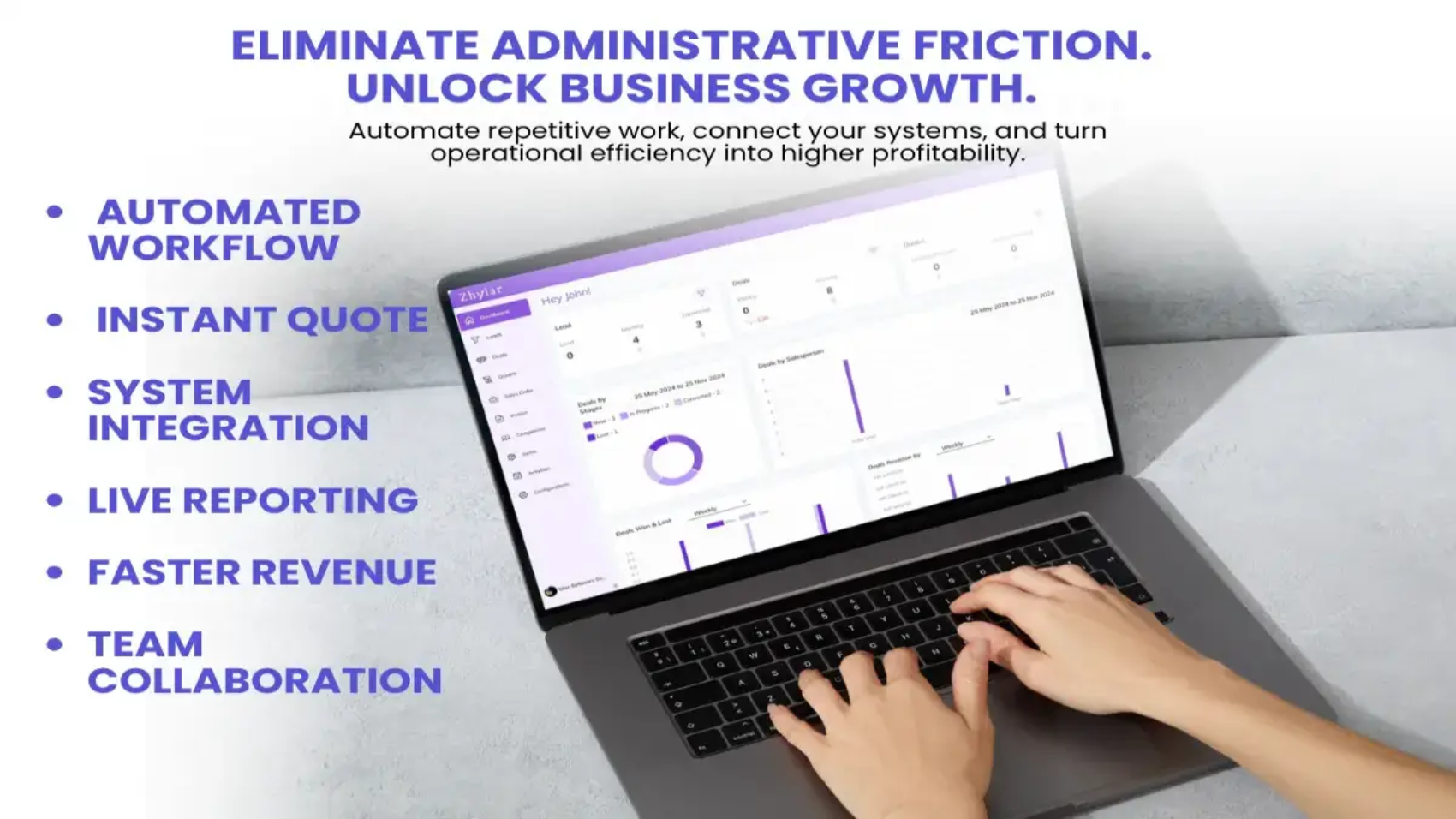
UAE businesses in 2026 are currently facing one of the most dynamic and competitive environments seen in recent years. Rising customer expectations, growing operational costs, increasing pressure for faster service delivery, and the rapid adoption of AI-driven technologies are changing how organizations compete.
For SMEs and growing enterprises, efficiency is no longer just an operational goal; instead, it has evolved into a critical requirement for most organizations.
However, while many organizations are primarily focused on generating revenue, reducing their marketing costs, or expanding their sales pipelines, one of the largest threats to their profitability often goes unrecognised: Administrative Friction.
Administrative friction is not just an inconvenience for organizations that are implementing digital transformation initiatives in the UAE but is rapidly becoming a major competitive disadvantage for those involved in these initiatives.
What Is Administrative Friction and Why It Matters
Administrative friction refers to the unnecessary complexity that is inherent in most of your routine processes. Things such as manual data entry, redundant approvals, disconnected systems, delayed communication between departments, and others. While each of these activities individually may not seem like a problem, together they slow down performance significantly.
Let’s understand this with a simple example:
Consider a typical workflow: The sales team produces quotes manually, sends the quote for approval via email, waits for response/feedback, revises the document, and then forwards them to clients.
Now multiply this same process for many employees, hundreds of sales quotes, multiple departments and thousands of operational transactions occurring every month.
The result is:
- Slower response times,
- Longer revenue cycles,
- Bottlenecks in the approval process,
- Operational confusion and errors,
- Lost sales opportunities,
This “small operational delay” quickly accumulates to have a negative effect on:
- Profitability,
- Scalability,
- Employee productivity,
- Customer satisfaction,
- Organizational agility.
Administrative friction cannot be viewed as simply an operations issue. It is a constraint on your ability to grow your business.
Why Administrative Friction Has Become a Strategic Risk in 2026
The business landscape has changed dramatically in the last several years.
Modern businesses are expected to:
- Work quickly,
- Operate efficiently,
- Provide customized customer experiences,
- Adhere to regulations, and
- Expand their operations without incurring additional administrative overhead.
The UAE government’s fast-paced digital economy and smart business initiatives continue to push businesses to enhance their operational systems.
Businesses that continue relying on fragmented systems and manual workflows are increasingly struggling due to:
- reduced operational visibility,
- inconsistent data,
- delayed decision-making,
- higher employee burnout,
- and slower rates of scalability.
Meanwhile, competitors adopting:
- automated AI solutions,
- integrated CRM ecosystems,
- cloud-based workflows,
- and real-time analytics
- are driving large-scale productivity
Digital maturity is creating a widening divide between highly functional and fragmented operationally based organisations.
The Hidden Cost of Inefficiency
Many organizations minimize or fail to see the actual costs of inefficiencies. Industry research demonstrates that a large number of employees are spending the majority of their time doing repetitive administrative work when they could be engaged in much more effective use of their time, by engaging in activities that are much more profitable.
Productivity Loss
The time that is used to perform manual tasks can be redirected to performing revenue-generating tasks. For example: sales teams spend a lot of time on creating and reworking proposals instead of closing deals.
Revenue Leakage
Delays in getting approvals, invoicing, or quoting directly impacts deal closures. When response times increase, customer interest declines.
Delays in obtaining approvals, invoices, and quoting impact the ability to close deals directly; the longer the delay, the less likely a customer will be interested.
Error-Driven Costs
The act of entering data manually increases the chance of error and results in additional time to fix or adjustments, possible compliance challenges as well as financial discrepancies.
Employee Burnout
Employees who perform repetitive tasks feel less motivated and connected to their work, which leads to increased costs related to employee turnover and the expense incurred related to replacing an employee.
The Bigger Blind Spot: Most Businesses Don’t Realize Friction Is Connected
One of the biggest operational blind spots is assuming inefficiencies exist in isolation.
In reality, administrative inefficiencies tend to create a chain reaction throughout the entire organization.
For example:
- Quotation delays (due to manual approvals) result in delayed cash flow realization for the business.
- Cash flow has a direct impact on operational cash flow and forecasting accuracy.
- A lack of consistency in the customer database creates misalignment between sales/marketing functions.
- Operational issues (due to operational delays) have a direct impact on the customer experience
This is why modern operational strategy is no longer about optimizing individual tasks.
It is about developing the integrated operational ecosystem; the ability of departments within the organization to communicate without barriers, real time data availability across the enterprise, synchronized systems, and minimal friction for workflows.
Businesses that fail to address these interconnected inefficiencies often experience difficulty scaling effectively.
Where Friction Commonly Occurs
Administrative inefficiencies are not confined to a single department. They exist across the organization:
Sales Operations
Manual quote generation, customer data spread out all over the place, and delays in getting approval results in bottlenecks. By implementing CRM automation UAE solutions, the bottlenecks can be significantly reduced.
Finance and Accounting
Disconnected systems create delays in processing invoices, reconciling accounts, and reporting on financial performance. By using accounting automation software UAE, the speed and accuracy of these processes can be enhanced.
HR and Administration
The people involved in the HR and administration roles typically perform repetitive, tedious, low-value-add tasks like onboarding new employees, payroll, and document management, etc. which could be streamlined through a HRMS automated UAE solution.
Marketing
Poor integration of the tools being used limits campaign effectiveness. By using a combination of Marketing automation solutions UAE together with CRM’s, better targeting and tracking can be achieved.
The Role of Digital Transformation in Reducing Friction
Digital transformation initiatives in UAE are being used by modern companies to improve administrative efficiency. By automating many manual processes and integrating existing systems, businesses are able to reduce the amount of time employees spend on repetitive tasks, thereby increasing their ability to perform other activities within their business.
Workflow Automation
Automating repetitive activities leads to consistent, less error-prone processes, while also allowing employees to use their time for other things.
System Integration
Integrating CRM and ERP systems, as well as other business tools removes barriers to data sharing, and provides for seamless flow of knowledge across various applications.
Real-Time Data Visibility
By having access to data in real-time, better-informed decisions can be made more rapidly, and there will be fewer delays related to the availability of up-to-date information.
The Power of Workflow Optimization
Workflow optimization software provides organizations in the UAE with a means of improving inter-departmental processes. These solutions identify areas of inefficiency between departments, establish standard procedures for carrying out tasks, and enhance inter-departmental collaboration.
Some of the many advantages of utilizing a workflow optimization application are as follows:
- Reduction in how long it takes to complete a task
- Increase in accuracy of task completion
- Increased productivity of team members
- Enhanced customer satisfaction
Take, for example, the impact of an optimized workflow on sales operations. By optimizing the workflow, organizations can reduce the amount of time required to produce and approve sales quotes. Many organizations that have implemented automated solutions claim to have reclaimed over 10 hours per week, time that can be used for strategic activities, such as building and maintaining client relationships and generating revenue.
System Integration: Breaking Down Operational Silos
Fragmented systems create one of the most significant barriers to smooth functioning between departments of any organization.
If there are multiple systems for managing customer relationships (CRM), enterprise resource planning (ERP), financial accounting, human resource management (HRMS) and communication platforms, it is difficult for organizations to operate effectively due to duplicate data, inconsistent reporting, lack of visibility, and delayed communication.
When these same systems work in harmony through integration, organizations can create a central operational environment which allows information to be available without barriers across departmental boundaries.
The resulting benefits include improved decision-making, forecasting, transparency of operations, and organizational agility.
Real-Time Visibility: The Foundation of Faster Decisions
Modern businesses need to use up-to-date reports and not rely on previous reports and fragmented spreadsheets. By having real-time visibility into operations, leadership teams can identify and eliminate bottlenecks in their operations quickly, view their performance immediately, utilize data for decision-making, and react quickly to risks in their operations.
This is becoming increasingly important in AI-driven business environments where speed and responsiveness create competitive advantage.
Workflow Optimization: Turning Efficiency Into Competitive Advantage
Workflow optimization software helps businesses to establish standardized operating procedures, remove redundancies from those procedures, and enhance collaboration across multiple departments.
Some of the major benefits include:
- reduced turnaround time,
- higher process accuracy,
- increased employee productivity,
- faster customer response times,
- and stronger scalability of business operations.
For example, one-way organizations realize this is by automating the processes of producing quotes for customers and obtaining approvals on those quotes – ultimately providing them with the opportunity to reclaim multiple hours of operational time each week.
Organizations can then use this reclaimed time in the following ways:
- Building better relationships with customers.
- Planning strategically for the future.
- Creating new revenue streams.
Therefore, creating efficiencies not only lowers costs, but also increases an organization’s potential for growth.
Automation in Action: Transforming Sales Efficiency
Sales processes often suffer from significant amounts of friction. Inefficiencies in lead management, proposal generation, and other sales tasks often lead to delays in closing deals.
Using CRM marketing automation integration tools can help to eliminate these inefficiencies by allowing businesses to:
- Automate lead tracking and follow up processes
- Create precise, instantaneous quotes
- Reduce approval delays
- Increase conversion rates
Modern systems will provide you with the ability to produce accurate instant quotes at no cost associated with paper transactions that will help to close deals faster, in addition to providing an efficient, consistent and professional means of communicating with prospective clients.
Enhancing Customer Experience Through Efficiency
Administrative friction affects not only how a business operates internally but also impacts their customers directly. Delays in responding to customer requests, providing inaccurate information, and inconsistent departmental communications can lead to customers losing confidence in a business.
With the implementation of customer experience optimization strategies in the UAE, a business can:
- Respond quickly to customer support requests
- Offer dependable, precise, and timely information
- Maintain consistent communication across multiple channels.
In today’s competitive environment, efficiency = time; thus, it is one of the primary ways to differentiate your business from others. A business must have the ability to meet their customers’ expectations for speed, precision, and dependability.
Measuring the Impact of Administrative Friction
Organizations must start by measuring their inefficiencies before they can effectively resolve them. Some common key metrics are:
- Time spent on administrative tasks
- Process turnaround time
- Errors made while entering data
- Productivity of employees
Using business analytics tools UAE, companies can identify where their bottlenecks are and prioritize their areas of improvement.
Overcoming Resistance to Change
Organizations may hesitate to adopt automation for several reasons, including cost concerns, complexity, or potential disruption.
However, the cost of not adopting automation is much greater. This is because companies that do not pursue a digital transformation will likely continue to fall behind their competitors who have already begun using technology to become more efficient.
Successful digital transformation requires more than simply purchasing software.
The factors that lead to successful implementation of automation are:
- Defined strategic goals
- Training employees and assisting them with their tasks.
- Introducing new tools and processes gradually rather than all at once.
- Continually monitoring performance.
This is why many organizations increasingly rely on experienced technology partners to help integrate systems, optimize workflows, improve adoption, and scale operations efficiently over time.
The Future of Work: Efficiency as a Competitive Advantage
As we move further into 2026, organizations that are efficient will be the leading organizations. Organizations taking advantage of the process automation UAE, cloud-based business solutions UAE, and integrated software ecosystems will outperform those that do not.
Some of the trends you are going to hear more about:
- Workflow automation through artificial intelligence (AI),
- Predictive analytics will help to make better decisions,
- Integration of digital ecosystems will speed up operations from end to end.,
- Increased adoption of cloud solutions
All of these advancements will eliminate many of the inefficiencies created by administrative friction, which will allow organizations to produce and deliver their products and services at a level they never have before!
Practical Steps to Eliminate Administrative Friction
If you’re running a business and want to increase performance, consider implementing these five steps:
Audit Existing Processes
Identify where one department’s activity is performed repeatedly and where bottlenecks exist between departments.
Invest in Automation Tools
Adopt workflow automation software UAE and integrated platforms to streamline operations.
Integrate Systems
Make sure that your customer relationship management (CRM) system, enterprise resource planning (ERP) system, and all other systems are integrated.
Train Employees
You need to ensure that everyone is being trained to use the new technologies.
Monitor and Optimize
Continuously monitor your processes and optimize them as needed.
Final Thoughts: Turning Efficiency into Profitability
Though administrative friction may be silent, its impact is significant. Left unaddressed, it can erode profitability, reduce productivity, and hinder growth.
To address this issue, businesses can embrace automation; streamline their processes; and utilize real-time, accurate data. An investment in these changes will not only reduce the current obstacles to productivity but will also generate new avenues for growth.
The question is not whether administrative friction exists in your organization, it does. The more pertinent question, however, is how much do you think it is costing you?
Now is the time to act. Assess your processes, identify inefficiencies, and explore modern solutions that can change how you do business. In order to compete with other businesses in this highly competitive, modern environment, efficiency is no longer merely an advantage; it has become a strategic requirement!
Frequently Asked Questions (FAQs)
1. What exactly is administrative friction?
Administrative friction refers to the inefficiencies found in the daily operations of a business, such as manual data entry, multiple levels of approvals, disconnected systems and communication delays. Individually, all these inefficiencies are very small, but when added together they can have a huge negative impact on business operations and slow business growth.
2. How much does administrative friction cost businesses?
Although administrative friction is hard to quantify, the research indicates some degree of administrative friction exists in almost every company. Companies could lose between 20 and 30 percent of their employee’s effectiveness due to administrative inefficiencies, which could translate into revenue that is not realized, the cost of correcting errors, and a reduced closure rate of deals (which can amount to 10-15 percent of profits).
3. Which departments experience the most administrative friction?
Sales operations (manual quoting and approving), finance (invoicing and reconciliations), HR (onboarding and payroll), and marketing (tracking campaigns) departments suffer most from disconnected systems and repetitive manual processes.
4. How does administrative friction impact customer experience?
Delays in quotes, inaccurate information, and inconsistent communication create a lack of confidence between the company and its customers. Slow response times directly correlate with lost deals and negative brand perception.
5. What role does CRM automation play in reducing friction?
CRM automation UAE solutionsallow for tracking of leads through the sales process, generating quotes immediately and eliminating long delays for approvals. The use of real-time visibility of customer data helps to ensure that decisions are not made based on outdated information.
6. Can small businesses benefit from workflow automation?
Yes, small and medium-sized enterprises (SME’s) experience significant improvement and regain roughly 10+ hours a week from automating quotes, invoicing and reporting. Using cloud-based platforms will allow SMEs to effectively scale with business growth.
7. How do you identify administrative friction in your organization?
Administrative friction is the result of bottleneck processes. To identify these administrative bottlenecks, you should audit your processes for: time spent on repetitive tasks, process turnaround time, data entry error rates and employee productivity levels. Compare the time taken to complete your workflows for manual versus automated systems.
8. What’s the ROI timeline for automation investments?
Most organizations report efficiencies of 15% to 20% within three to six months of using an automated system, with improvements to revenue by 25% to 35% within year one due to faster deal cycles and less operational costs.
9. How does system integration eliminate administrative friction?
By integrating CRM, ERP, accounting and HR systems, you are able to create one seamless data flow, which means there is no longer a need to reenter data, as well as providing real-time visibility of data, and allowing for collaboration between different departments.
10. What are the first steps to eliminate administrative friction?
- Prioritize processes with the highest level of impact (e.g., quotes and invoices)
- Implement workflow automation tools in the UAE
- Educate employees on how to use their new systems
- Continuously monitor your key performance indicators (KPI’s) and optimize accordingly.